Freelancers often look cheaper and faster to onboard, while companies appear safer and more complete. The right choice depends on your project complexity, internal technical capabilities, and long-term ownership requirements.
In this guide, we’ll break down the key differences, costs, risks, and real-world use cases to help you choose the right approach.
What is the difference between an AI development company and a freelance AI developer?
The primary difference between a freelance AI developer vs AI company lies in scope and structure.
An AI development company provides a structured, cross-functional team. This entity brings broader capabilities to the table, including project managers, quality assurance (QA) engineers, MLOps specialists, and dedicated support staff. They handle the entire lifecycle of a product, from architecture to post-launch maintenance.
A freelance AI developer is an independent specialist. They offer flexible engagement and operate within a narrower execution scope. When comparing an AI consulting company vs freelance AI engineer, the freelancer focuses primarily on writing code or tuning models based on specifications you provide. You act as the project manager and assume responsibility for testing, integration, and deployment.
AI development company vs freelance AI developers at a glance
Understanding the trade-offs between AI development services vs freelance developers requires a clear look at capabilities. Compare the differences between an AI software development company vs a contractor below.
When hiring a freelance AI developer makes sense
You should hire a freelance AI developer talent when your project has a tightly defined scope and you already possess strong technical leadership in-house. A freelance setup thrives on clear boundaries.
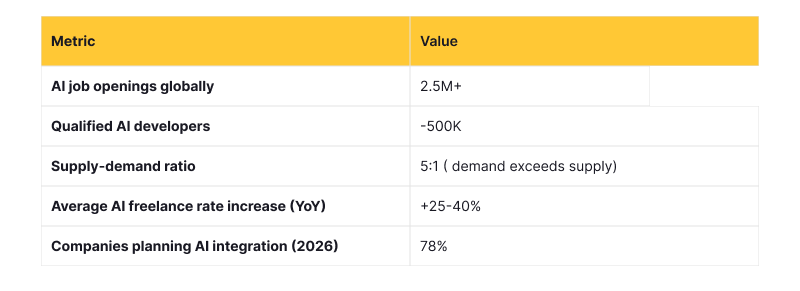
According to research by Idlen, demand for AI talent significantly exceeds supply, with an estimated 5:1 ratio of open roles to qualified developers. This imbalance has driven freelance AI rates up by 25–40% year-over-year, while companies continue accelerating AI adoption.
As a result, hiring a freelance AI developer is most effective when you have a clearly defined, short-term need and can move quickly to secure available talent before costs or availability shift further.
Source: Idlen
Proof of concept
Freelancers excel at testing ideas. If you need to validate a machine learning assumption quickly, an independent developer can build a lightweight model to prove feasibility.
Chatbot prototype
Building a simple conversational interface using an existing API requires specific but limited effort. A freelancer can deliver a functioning prototype for stakeholder review without the overhead of a full agency.
“In one recent case involving an AI chatbot and appointment scheduling solution, the client moved forward after several initial meetings that helped establish trust and demonstrate the team’s professionalism and capabilities. Ultimately, the decision was influenced not just by technical expertise, but by familiarity, trust, and strong referrals—factors that often lead clients to choose a structured team over an individual freelancer.”
— Ihor Churilov, Sales Manager of Globaldev Group
Short-term AI audit
If you need an expert to review your existing machine learning architecture or data pipelines, hiring a specialized freelancer for a two-week audit provides high ROI.
One-off model tuning
Fine-tuning a specific open-source model on your proprietary data is a highly technical, self-contained task. A freelance AI engineer can execute this without needing a broader product team.
Temporary expert help
When your internal team lacks a specific skill, such as computer vision or natural language processing, a freelancer can bridge the gap temporarily.
Internal technical team already in place
Freelancers integrate well when you already have internal developers, a project manager, and a QA process.
Founder has a CTO managing the work
If your startup has a technical co-founder capable of reviewing AI code and managing architecture, AI engineers for hire provide excellent execution leverage.
When an AI development company is the better choice
You must evaluate when to hire an AI development company based on production complexity. Building AI that scales requires more than just machine learning scripts; it requires robust software engineering.
According to McKinsey & Company, around 55% of organizations globally have adopted AI in at least one business function, highlighting how widespread AI implementation has become across industries. Yet many still struggle with the technical capabilities required to scale these systems. Combined with ongoing AI talent shortages, this gap often leads companies to rely on external partners to accelerate development and reduce implementation risk.
Building an AI MVP that must launch reliably
A Minimum Viable Product intended for actual users needs a backend, a frontend, security, and cloud infrastructure. An AI development company provides the full team necessary to launch a complete, reliable product.
Enterprise integrations
Connecting an AI solution to legacy enterprise resource planning (ERP) or customer relationship management (CRM) systems requires deep integration expertise and stringent security protocols.
RAG/LLM apps connected to internal systems
Retrieval-Augmented Generation (RAG) applications demand secure data pipelines, vector database management, and ongoing hallucination controls. Teams handle this complexity better than individuals.
Regulated or sensitive-data environments
Healthcare, finance, and legal sectors require strict compliance (e.g., HIPAA, GDPR). The benefits of hiring an AI development company include access to established data security frameworks and compliance expertise.
Products needing design, backend, MLOps, QA, and support
Production AI is 10% model and 90% surrounding infrastructure. An agency supplies the UI/UX designers, backend engineers, and MLOps specialists required for a functional product.
Teams without internal AI leadership
If you lack a technical founder or CTO, an AI agency acts as your technical partner, guiding architecture decisions and preventing costly structural mistakes.
Long-term roadmap ownership
An agency provides continuity. They maintain documentation and institutional knowledge, ensuring your product continues to evolve even if individual developers change.
When comparing an AI development company to freelance AI developers, the key advantage of a company lies in the consistency of processes and access to a broader pool of expertise. AI companies typically operate with established workflows, quality controls, and delivery standards, which ensures predictable outcomes and reduces operational risks. In addition, they can involve multiple specialists. depending on the project’s needs. This collaborative approach leads to more robust, scalable, and well-rounded solutions, whereas freelancers often work in isolation, which can limit both the depth of expertise and the continuity of delivery over time.
— Kate Chernel, VP Customer Success of Globaldev Group
AI development company vs freelancer cost: what is actually cheaper?
Evaluating AI development company vs freelancer cost requires looking past the hourly rate. While freelancers boast lower visible hourly costs, outsourced AI development vs freelancers involves fundamentally different risk profiles.
Visible cost
Freelancers typically charge between $30 and $100 per hour. Agencies charge between $50 and $150+ per hour. On paper, the freelancer wins the visible cost comparison.
Hidden cost
Managing a freelancer takes time. If you spend 10 hours a week managing an independent developer, your own hourly rate becomes a hidden project cost.
Rework cost
Without strict QA or architectural foresight, freelancer code often requires rebuilding before it can handle production traffic. AI project outsourcing vs hiring freelancers usually results in less rework because agencies build for scale from day one.
Management overhead
Agencies include project managers who track timelines, manage sprints, and handle blocker resolution. With a freelancer, you absorb all management overhead.
Vendor-switch cost
If a freelancer leaves mid-project, you lose all momentum. Onboarding a new developer to read undocumented code incurs massive delays. Agencies absorb staff turnover without halting your project.
Freelancer costs can be lower when:
- The project scope is exceptionally narrow.
- The technical specifications are 100% complete.
- Your cloud infrastructure already exists.
- No formal QA or compliance certification is needed.
Company costs can be lower in total when:
- Multiple functions (design, integration, QA) are needed.
- The scope is still evolving and requires strategic product guidance.
- A strict launch deadline matters.
- Long-term support and iterative updates are required.
Risks of hiring freelance AI developers
The risks of hiring freelance AI developers stem primarily from resource limitations and lack of structural oversight.
Single point of failure
If your freelancer gets sick, takes another job, or simply stops responding, your project halts entirely.
Inconsistent availability
Freelancers juggle multiple clients. Your critical bug fix might wait behind another client's deadline.
Weak handoff and documentation
Independent developers often prioritize writing code over documenting it. This leaves you with a "black box" system that is difficult for future engineers to understand.
Limited QA
A developer testing their own code rarely catches edge cases. You risk deploying AI with unhandled errors.
Narrow specialty mismatch
AI is a vast field. A freelancer skilled in predictive analytics might struggle deeply with natural language processing or computer vision.
Security and process gaps
Freelancers rarely maintain SOC2 or ISO certifications. Handing them sensitive proprietary data introduces massive business risk.
Dependency on one person
Your intellectual property and institutional knowledge live entirely in one person's head.
No guaranteed post-launch support
Once the contract ends, the freelancer moves on. If a model drifts or an API breaks three months later, you have no guaranteed support line.
“A developer within a company is already a vetted specialist with proven experience who has passed a structured selection process. For clients, this significantly reduces risk compared to freelancers, about whom there is often limited verified information.”
— Oksana Zhukova, COO of Globaldev Group
Risks of hiring an AI development company
Working with an AI product development partner mitigates many technical risks but introduces different operational challenges.
Higher upfront budget
Agencies require a larger initial financial commitment. They often mandate paid discovery phases to map out architecture and requirements.
Slower onboarding in some cases
Spinning up an entire cross-functional team takes more time than signing a contract with a single independent developer.
Possible communication layers
Working through a project manager can sometimes slow down direct technical communication between you and the lead engineer.
Process overhead
Agencies rely on strict processes, Jira boards, and sprint planning. For very small, casual projects, this overhead feels unnecessary.
Variable quality between agencies
Not all AI agencies possess deep AI expertise; some are standard web dev shops using wrapper APIs. Vetting their technical depth is mandatory.
Risk of junior team substitution
Some agencies sell you with their senior architects but staff your project with junior developers. You must contractually secure the seniority of your team.
Lock-in if discovery and documentation are weak
If you do not own the source code, infrastructure accounts, and documentation, leaving the agency becomes incredibly difficult.
How to choose between an AI company and freelance developer
Deciding how to choose between an AI company and a freelance developer requires a structured evaluation of your business needs. Use the framework below to assess whether a dedicated AI development team vs freelancer is the right path.
Evaluate your project across these vectors:
- Project scope: Is it a standalone script or a full software product?
- Business criticality: If the AI fails, does your business lose money immediately?
- Internal technical leadership: Do you have a CTO to oversee the work?
- Data sensitivity: Are you handling personally identifiable information (PII)?
- Speed-to-launch: Do you need parallel workstreams (design, frontend, AI) moving at once?
- Required integrations: Does the AI need to talk to five different enterprise APIs?
- Need for support: Will the model require ongoing tuning and monitoring?
Decision matrix
Best option for startups: AI agency or freelancer?
The freelance AI developer vs agency for startups debate relies heavily on the startup's current lifecycle stage.
Pre-seed idea validation
At the pre-seed stage, you need to prove a concept to raise money. You do not need scalable infrastructure. A freelancer is often the most capital-efficient way to build a raw prototype.
Seed-stage MVP
When building an MVP for early customers, the best option for building an AI product company or freelancer depends on the product. If it is a simple tool, a freelancer works. If it involves complex user data, secure logins, and payment gateways, you need a structured agency team.
Post-PMF scaling
After finding product-market fit (PMF), scale and reliability become your primary metrics. At this stage, transitioning from a solo freelancer to an AI agency (or building an in-house team) is mandatory to prevent technical debt from crushing your growth.
AI development partner vs freelancer for generative AI apps
Building modern Generative AI requires specific operational infrastructure. When evaluating an AI development partner vs freelancer for generative AI app creation, the complexity heavily favors structured teams.
Generative AI development services entail much more than sending prompts to the OpenAI API.
LLM orchestration and RAG
Connecting Large Language Models to your proprietary databases via RAG requires secure vector databases and complex data chunking pipelines.
Prompt engineering is not enough
An application needs evaluation pipelines to score the accuracy of AI outputs programmatically before users see them.
Hallucination controls
Preventing an LLM from giving false information requires strict guardrails, semantic routing, and fallback mechanisms.
Observability
You must track token usage, latency, and user feedback in real-time. This requires specialized MLOps dashboards.
Security and governance
Preventing prompt injection attacks and ensuring data privacy requires enterprise-grade security protocols.
Model and provider switching
Relying on one model is dangerous. Machine learning development services build agnostic architectures that allow you to swap from GPT-4 to Claude or a local open-source model seamlessly.
Ongoing improvement after launch
Generative AI apps require continuous fine-tuning based on user interactions. Agencies provide the ongoing data engineering support needed to facilitate this.
Real-world decision scenarios
Compare an AI app development company vs independent developer across these common project types.
Checklist: questions to ask before you hire either option
Whether you hire AI development company teams or hire freelance AI developer specialists, ask these fundamental operational questions before signing a contract.
- Who owns the system architecture and cloud accounts?
- Who is responsible for deploying the code to production?
- Who writes the automated tests for the software?
- Who monitors the model for drift or errors after launch?
- Who documents the system architecture and APIs?
- Who handles the security review and vulnerability scanning?
- What happens to my project if the lead engineer leaves?
- What specific post-launch support is included in this contract?
Final verdict
The choice between an AI development company vs freelance AI developers comes down to your capacity to manage technical complexity.
A freelance AI developer is the best choice for focused tasks, early experimentation, and staff augmentation where you hold the technical reins. They provide speed and specialized skills at a lower visible cost.
An AI development company is the best choice for production-grade software, complex enterprise integrations, data security, and long-term reliability. Outsourced AI development to a structured agency minimizes your risk, guarantees delivery, and provides the complete cross-functional team required to turn a raw machine learning model into a successful, scalable product.
If you're still unsure which approach fits your project, it's worth discussing your goals, timeline, and technical requirements with experienced AI engineers. A short consultation with Globaldev can help you avoid costly mistakes and choose the right path from the start.