Farmers and agribusinesses are moving beyond pilots and finding genuine value in AI-assisted operations. Healthier crops, real-time field condition monitoring, higher process efficiency, reduced manual labor, and better harvest quality are no longer theoretical.
In this article, we cut through the hype and look at how artificial intelligence in agriculture is implemented today, where it works best, and what to consider when building a business case.
What is AI in agriculture?
AI in agriculture — also known as precision agriculture — is the application of artificial intelligence solutions to improve farming operations. The technology is used across field harvesting, health monitoring, weed and pest control, nutrient deficiency detection, and more.
More specifically, AI in agriculture refers to software, models, and autonomous systems that sense, interpret, and act on farm data to improve decisions and operations. Common sub-domains include:
- Computer vision for crop, weed, and disease identification
- Robotics for weeding, harvesting, and targeted spraying
- Decision support combining agronomic models with machine learning
- Forecasting and optimization for yield, irrigation, and logistics
- Natural language tools that surface recommendations and summarize records
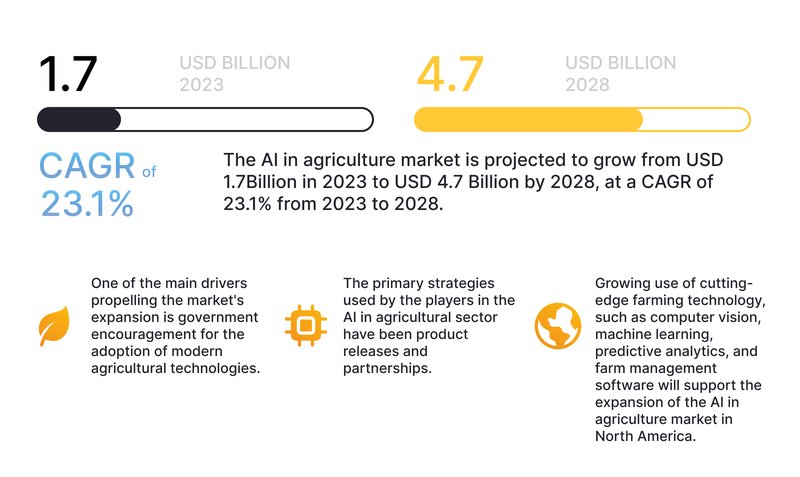
Business interest continues to rise. The global AI in agriculture market is projected to grow from $1.7 billion in 2023 to $4.7 billion by 2028, driven by labor constraints, sustainability targets, and maturing hardware and software.
How AI in agriculture works
Under the hood, most AI agriculture solutions combine four building blocks:
- Data capture. Sensors — RGB and multispectral cameras, LiDAR, soil moisture probes, weather stations, GNSS — collect ground truth from robots, drones, tractors, or satellites.
- Models. Computer vision models classify plants and detect diseases. Time-series models forecast yield or irrigation needs. Machine learning-powered algorithms trained using transfer learning fit specific crops and regions.
- Processing and orchestration. Edge inference handles time-critical tasks like laser weeding; cloud processing supports heavier analytics and fleet learning. Orchestration services schedule missions, sync data, and version models.
- Integration and action. Outputs flow into farm management systems, equipment controllers, or variable-rate application maps. Closed-loop setups can automatically adjust nozzles, irrigation valves, or booms when confidence thresholds are met.
A practical deployment relies on an MLOps lifecycle: data collection, labeling, training, field A/B testing, monitoring, and safe rollback. For most use cases, a human-in-the-loop remains essential for exceptions and compliance.
AI agriculture use cases
Here are the six areas where AI is already making a measurable difference:
1. Automatic weeding
Weeds steal sunlight and nutrients, and make it easier for pests to harm crops. Today’s farmers have a powerful new weapon: autonomous robots that use lasers to kill up to 100,000 weeds per hour.
Multiple models are already available on the market, including those from Carbon Robotics and Farmwise. Here’s how it works in practice:
- Perception. Downward-facing RGB or multispectral cameras, sometimes aided by LiDAR, capture plants at row level. AI models segment each plant, classify crop vs weed, and localize stems even under partial occlusion.
- Actuation. High-energy lasers thermally ablate weeds, or mechanical tools uproot them. Guidance fuses GNSS, IMU, and visual odometry for centimeter-level targeting.
- Operations. Robots navigate autonomously with safety interlocks and geofences, with remote dashboards and mobile apps for mission control. Processing speed: up to 12 acres in 9 hours.
Beyond reducing tedious manual labor, automatic weeding minimizes herbicide use — which keeps soil healthier and drives higher outputs.
Here’s a view of the planted row of crops from the robot’s camera. As you can see, AI software assigned each crop type a unique ID. It’s a way to differentiate them from weeds that have no IDs.
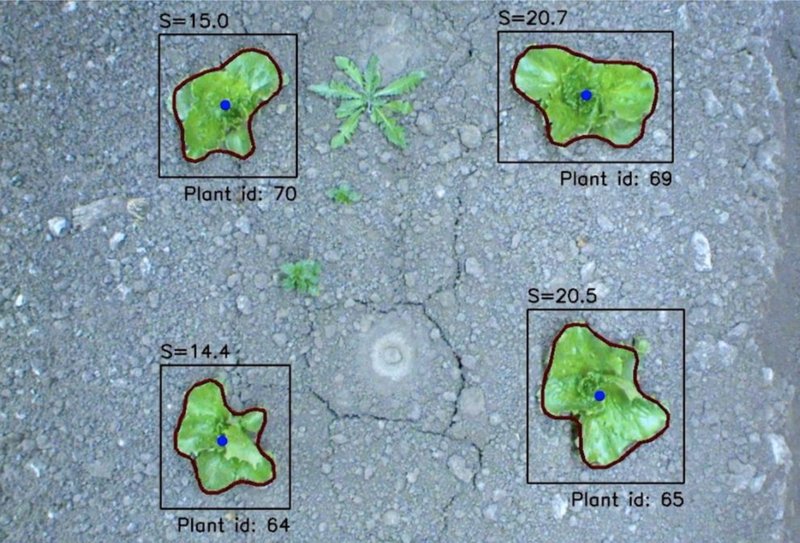
Source: MITAlumni
And a great thing is — you can control this process on your smartphone. All that’s needed is a custom mobile app developed for this purpose. Yes, you can dispatch your robotic laborer in the morning and watch its progress from anywhere.
Here’s an example of how such a machine works, based on ecoRobotix’s AVO autonomous weeding robot.
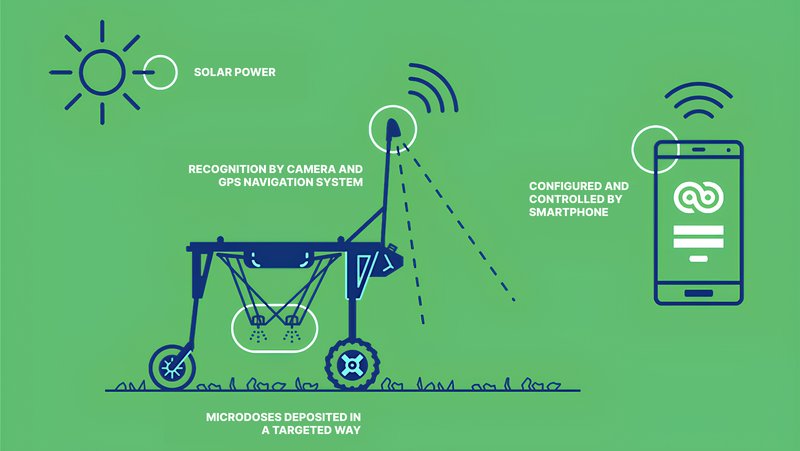
Various manufacturers suggest different performances of weeding robots.
Here are some highlights based on our findings:
- Processing speed: up to 12 acres in 9 hours
- Fully autonomous thanks to camera navigation
- Precision guidance (GPS and camera)
2. Automatic harvesting
Costly. Inefficient. Prone to error. Those are the words associated with manual harvesting — and why AI-driven robots are rapidly entering the market.
An automatic harvesting robot combines a camera, AI software, and mechanical arms. The software uses the camera to recognize vegetables or fruits and instructs the arms to pick them. Key specs to evaluate:
- Throughput and selectivity. Pick rate varies by crop, canopy structure, and lighting. Robots can work 24/7 and are over 90% effective in structured greenhouse environments.
- Damage and error modes. False positives (picking unripe fruit) and false negatives (missing ripe fruit) directly affect revenue. End-effector design and force control are critical.
- Human-in-the-loop. Many growers pair robots with human crews for edge cases and quality control, especially in open fields.
Platforms like Root AI have demonstrated continuous operation with ripeness-aware vision-guided grippers for tomatoes and peppers.
3. Plant disease detection
Up to 40% of global food production is lost due to plant diseases and pests. Vision-based disease identification helps growers act earlier and more precisely.
The workflow is straightforward: take a photo of a plant, run it through image recognition software, and get disease information, treatment recommendations, and pest identification. Apps like Plantix have built databases of 100,000+ photos of sick plants to identify over 60 diseases.
The same models can run on greenhouse cameras, drone payloads, or boom-mounted sensors to continuously monitor larger areas. In vineyards, AI-supported aerial scouting has reduced losses from grapevine disease by up to $15,000 per acre through earlier intervention.
Key technical considerations: high-quality labeled datasets, precision/recall trade-offs over raw accuracy, and privacy controls for imagery containing location or operator data.
4. Improved soil health monitoring
The ability to detect disease in the soil is essential to prevent yield loss. Traditional analysis techniques have their limits — and that’s exactly where AI has started making a difference.
A typical AI soil monitoring workflow:
- A soil sample is taken to identify all present microbes and their content
- A machine learning algorithm compares the sample data against a large soil database
- Results indicate moisture, nutrients, pH, microbes, and pathogen risk
- Specialists define treatment recommendations informed by actual soil biology — not guesswork
Unlike traditional methods, this approach offers more comprehensive soil biology and chemistry analysis. Farmers who use it report they get genuinely actionable insights about pathogens — including farmers like the Schweigerts, who noted that conventional analysis is "nowhere near" as deep as AI-driven alternatives.
5. More efficient irrigation of farmland
Agricultural irrigation accounts for 70% of water use worldwide. AI helps by combining soil moisture telemetry, weather forecasts, crop stage, and canopy indices to recommend timing and amounts — or by detecting malfunction in irrigation systems.
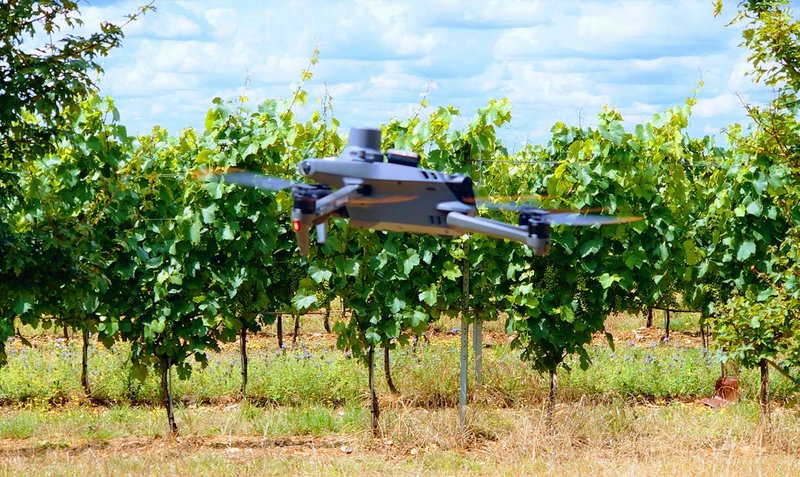
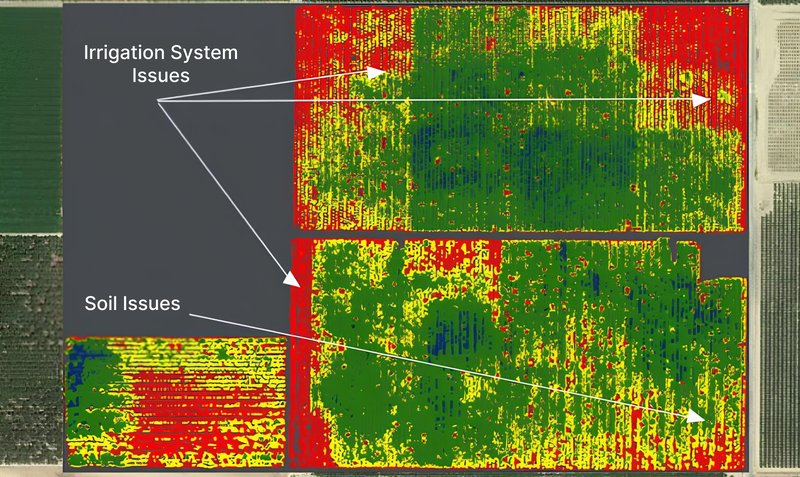
AI-equipped drones fly weekly over fields, capturing high-resolution aerial imagery. The software analyzes footage and surfaces problems like clogs and leaks, often weeks before they become apparent. When connected to variable-rate systems, rules can autonomously adjust valve timing within safety bounds.
Outcomes typically include less overwatering, earlier leak detection, more consistent crop quality, and lower chemical usage — with benefits compounding across the season.
6. Application of pesticides and herbicides
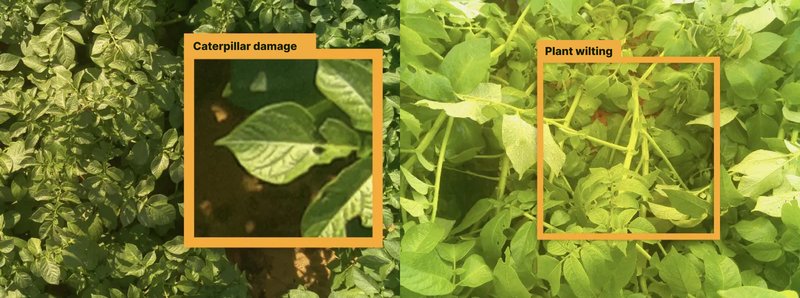
Computer vision and robotics drive targeted spraying that reduces chemical use and drift. Drones and ground rigs equipped with cameras detect weeds or disease-affected zones and apply inputs only where needed.
Benefits of AI-driven targeted application:
- Identify pest attacks and plant health problems at scale
- Reduce excess use of pesticide and herbicide
- Improve soil fertility maintenance over time
- Slow resistance development when paired with integrated pest management
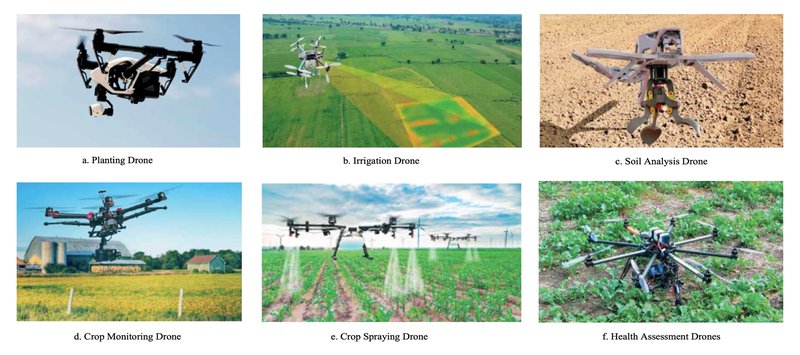
Research confirms that crop-spraying drones simplify field management, reduce human effort, and improve yields.
Technical trade-offs and risks
AI in agriculture delivers real value, but results depend on realistic expectations:
- Accuracy vs cost. Higher model accuracy requires more labeled data and compute. Marginal gains can be expensive; calibrate to the decision threshold that matters economically.
- False positives/negatives. Missing a disease outbreak can be more costly than an unnecessary spray, but frequent false alarms create alert fatigue. Tune models to your risk tolerance.
- Weather and environment. Dust, glare, rain, and canopy occlusion degrade sensors and inference. Plan for seasonal retraining.
- Maintenance and uptime. Robotics add wear on actuators, optics, and filters. Stock spare parts to protect critical seasonal windows.
- Safety and data governance. Autonomous machines must detect people and respect geofences. Prefer open data formats and clear exit clauses to avoid vendor lock-in.
Challenges in adopting AI agriculture solutions
Many decision-makers hesitate to adopt AI in agriculture, thinking: “AI is too complicated,” “It’s too risky or expensive,” or “Shouldn’t I wait to see more benefits first?” These concerns are normal — and manageable.
- Data readiness. Historical data may be messy or siloed. Start by standardizing identifiers and establishing data contracts for new streams.
- Connectivity gaps. Remote fields may lack reliable coverage. Design for intermittent networks and edge inference.
- Change management. New workflows succeed only when operators see value. Involve crews in design, keep interfaces simple, and provide hands-on training.
- Integration complexity. Legacy FMIS and proprietary controller protocols complicate deployments. Favor open interfaces and modular architectures.
- Capex and opex. Stage investments, lease where sensible, and align spending with seasonal windows to de-risk.
- Regulatory and safety compliance. Drones, autonomous vehicles, and chemical applications must comply with local rules. Bake compliance into design from the start.
From pilot to scale: implementation and ROI
A practical, lower-risk path is to start narrow, prove value on one or two fields or greenhouses, and scale in phases:
- Discovery. Define the agronomic objective and decision thresholds. Inventory sensors, equipment, and data sources.
- Pilot build. Stand up data pipelines, label a representative dataset, and fine-tune models using transfer learning.
- Field validation. Run side-by-side comparisons or A/B tests to measure impact on chemical use, labor hours, or quality. Involve operators early.
- Integration. Connect outputs to FMIS and equipment controllers. Establish telemetry, OTA updates, and model monitoring.
- Scale-up. Expand to additional fields; harden MLOps with versioning, drift detection, and rollback procedures.
Typical timelines: proof of concept in 6–12 weeks; limited deployment in 3–6 months; fleet scale in 12–24 months. When evaluating ROI, model both direct savings (chemical, water, labor) and indirect value (quality premiums, yield stability, compliance documentation).
Build vs buy and vendor selection
Deciding whether to adopt off-the-shelf tools or build custom solutions depends on your crops, environment, and integration needs.
Buy when the use case is standardized and the vendor can prove field performance on your crop in your conditions. Look for clear performance metrics, integration options, and transparent data policies.
Build or co-build when differentiation matters, environments are unique, or deep integration with proprietary processes is required. A hybrid approach is common: off-the-shelf hardware plus custom perception models and workflow software.
How Globaldev can help
AI for agriculture addresses the three most critical issues of farming: overuse of chemicals, tedious manual labor, and process inefficiency. The technology is making quick progress — and more agricultural businesses are expected to operate AI solutions within the next few years.
With Globaldev Group, you can build custom AI software to grow your agricultural business. We combine data engineering, computer vision, and edge-to-cloud orchestration with user-friendly applications for operators and agronomists. Feel free to go through our case studies to learn more about our experience, or contact us about the AI and ML software development you need.
Closing thoughts
AI is reshaping how farms scout, decide, and act. From precision weeding and selective harvesting to disease detection, irrigation optimization, and targeted spraying, the gains are real — when solutions are designed around agronomic realities and integrated with existing operations.
The path to value is practical: start focused, validate in the field, and scale with robust data and MLOps practices. If you’re exploring artificial intelligence in agriculture and need a partner who can translate goals into production systems, Globaldev is ready to help.