That’s a wide range, and for good reason. The final price depends on multiple factors — from the complexity of features and chosen tech stack to developer rates across different regions.
If you’re looking for a more precise estimate, read on. We’ll break down the key cost drivers and share practical tips to help you budget smarter.
What is the approximate app development cost?
Over the past 14 years, Globaldev Group has built hundreds of apps for businesses of all sizes. We learned that several key factors contribute to the price: technology, functionality, labor costs, and others.
Together, these things can contribute to a mobile app price from $10,000 to $300,000. However, the best way to determine a specific price is to provide your software vendor with more detailed information.
We know what you’re thinking. For most businesses, the price of $300,000 is a bit much. But that is one of the top prices for complex software products, the kind that small and mid-sized businesses rarely ever need.
Our experience with small and mid-size businesses shows that a budget between $10,000 and $50,000 is typically enough. For this budget, you can still get the app you need with the most required features.
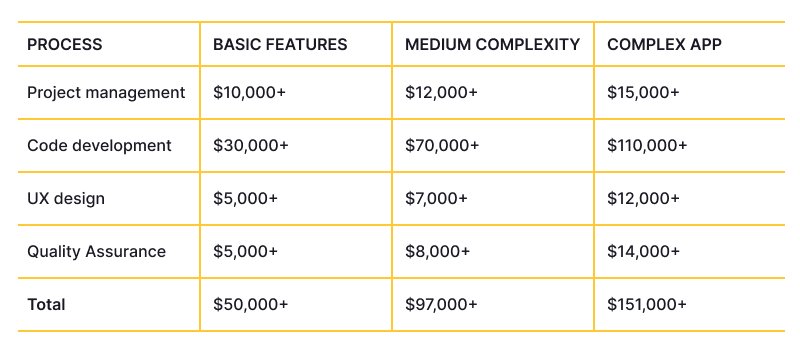
Let us break down the cost of apps of different complexities based on the approximate price of the involved processes: project management, code development, UX design, and Quality Assurance.
Cost of creating an app: 5 factors
Now, let’s see what goes into the cost of app development.
#1 Features, aka complexity
The more features an app has, the higher its cost. But that doesn’t mean you can’t develop a good app on a limited budget. To keep your spending within appropriate limits, you can choose the most important features to be created. Let’s see some examples of different functionality levels.
In the table above, you saw three of them: “basic features,” medium complexity,” and “complex.” Each of them has a different set of features.
The basic app will have these features:
- Newsfeed
- Geolocation
- User profiles
- Search option
- Payment options
- In-app notifications
Examples of such simple apps include note-taking apps, news, fitness trackers, book reading, podcasts, and others.
Let’s move on to medium-level complexity apps.
They could have this functionality (in addition to the basic features):
- Social media integrations
- Effective cybersecurity
- Custom business features
- In-app messaging
- Location tracking
- More complex payment portals
The functionality for a mid-level app is enough for many business goals. For example, you can make an app for food delivery, for your ecommerce store, or even a concert venue.
Next up, complex apps. They can have these features:
- Video chat
- Live streaming
- 3rd party integrations
- Analytics and reports
- Sync with existing software
- Complex cybersecurity tools
- Almost any business features
- Native features
Basically, you can develop any kind of app with this functionality.
How long does it take to make them? A basic app can be developed within 300 work hours. An application of medium complexity usually takes from 500 to 800 hours. And complex applications take 800+ working hours to develop due to their diverse functionality.
#2 Operating system
Do you want your app to run on Android or iOS devices? Or maybe both?
The platform of choice also influences the final price. For example, in our experience, the cost of developing an app for Android is cheaper compared to iOS.
Android is an open-source platform, which makes it easier to work with. Developing for Android is faster as well. We’d say Android app development projects can usually be completed up to 30% faster than iOS apps. Also, Android dominates the mobile OS market.
However, a lower cost of creating an app doesn’t mean you need to focus on Android devices. If you’re building an ecommerce app for your business, then iOS should be your first choice. Various studies consistently suggest that iPhone users spend more time than those with an Android phone.
Besides making apps to run exclusively on Android or iOS, you have one more option: cross-platform apps, like this one we built for ECIT.
A cross-platform program is a type of app that runs on both platforms. The cost of developing a hybrid app will be lower than making two native versions for both Android and iOS. Besides, this kind of app is easy to maintain and scale.
But native apps outperform cross-platform apps in terms of performance, user experience, and functionality.
Drop us a message if you need our experts to explain more details and help you make the best choice for your app.
#3 Development team size
A basic team needed for app development consists of a project manager, a software engineer, a backend developer, a UI/UX designer, and a QA engineer. For more complex projects, it can be extended by hiring several programmers, a couple of QA engineers, and a system administrator.
Here are the duties of each.
- Project manager. Designs and applies app development standards, manages the production, and develops the project scope, analyzing all the risks and pitfalls. Acts as a liaison between the team and the client.
- Software developer. Writes the code of an app, recommends future application upgrades, performs bug fixing, and documents the development process for further work on the product.
- Back-end developer. Plans and develops the server-side logic and architecture of an application. Integrates these parts with the user interface elements created by software engineers
- UI/UX designer. Creates the layout for a future app and defines what an app is going to look like, as well as how users will interact with it.
- QA engineer. Follows every stage of the development process, tests the performance of an app, and ensures its smooth and stable performance.
#4 In-house or offshore development
You have two options for app development: hiring an in-house team or outsourcing this task to a team overseas. In many cases, choosing the second option is a way to reduce the cost of app development. By how much?
Take a look at these hourly rates:
- North America: $100-$250 hourly
- Australia: from $80 to $150 per hour
- The UK: from $50 to $150 per hour
- South America: between $25 and $70 per hour
- Eastern Europe: the two leading destinations here are Ukraine and Poland with $34-$64 and $40-$77 hourly rates, respectively
- India: $15 to $40 per hour of work. Meanwhile, Indonesian app developers charge $20 at max
#5 Maintenance
This is the last point to consider when planning the cost to develop an app.
When an app is released, developers will need to make corrections and changes based on the feedback of users.
Regardless of the platform, team size, or functionality, your app will require:
- Bug fixing
- Developing new features
- Stability improvements
- Making updates to match new OS versions
Take bug fixing as an example. Regardless of how thoroughly QA engineers might have tested the app, it’s impossible to detect all of them without real users. To eliminate the risks, we recommend that you release the MVP version of an app first.
Closing thoughts
App development costs vary, but the main drivers are always the same: features, platform, team setup, and ongoing support. The best way to get a reliable estimate is to look at similar projects and see what it actually took to build them.
Globaldev has worked on everything from small MVPs to larger business apps, so we know how these choices play out in real budgets. You can explore our case studies to see concrete examples of apps and digital solutions we’ve developed over the years.