One of those key processes is called CRM, or Customer Relationship Management. On one hand, it helps you understand what your audience wants and needs. On the other, it shows how to deliver on those needs better than your competition.
By understanding your audience better, you can not only provide better experiences and services but also create better products. And you can achieve all of that with a solid CRM process.
What is the customer relationship management process?
Customer relationship management (CRM) is the strategy an organization implements to build and maintain positive relationships with its existing customers and prospects. The goal of the CRM process is to build brand awareness and loyalty, improve customer service relationships, assist in customer retention, and drive sales growth.
The CRM process involves the management of customer data, information analysis, and generating reports to gain insights. CRM covers all aspects of customer-related operations, such as sales, marketing, and customer service.
And since CRM heavily relies on data, organizations utilizing this type of process require dedicated software. CRM solutions help companies organize their customer databases, generate reports about a variety of customer activities, and share that data across departments.
So, a complete CRM strategy combines technological tools and traditional marketing strategies, like customer segmentation and target audience campaigns, to maintain relationships with customers. The goal is to create and maintain personalized interaction with customers. Whereas the CRM software collects the necessary data needed to execute the said strategy.
What are the steps of the CRM process?
The CRM is a process; therefore, it consists of a set of specific steps. However, before we can venture into it, you need to understand the customer lifecycle first.
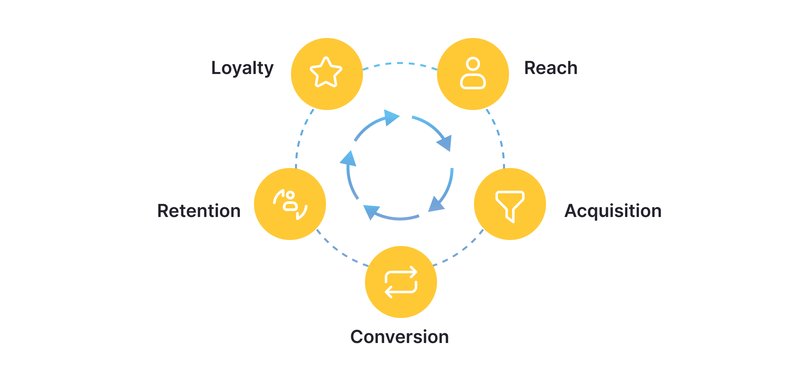
The customer lifecycle is the process that prospects go through several stages. It starts with potential customers becoming aware of a product, then making a purchase, and finally, becoming a company’s loyal customer (in an ideal scenario).
The customer lifecycle process comprises five stages:
- Reach
- Acquisition
- Conversion
- Retention
- Loyalty
The customer lifecycle process outlines the steps a customer takes as they progress through the sales funnel. The huge advantage is that it gives marketing, sales, and customer service teams a complete overview of the customer’s journey. It also highlights areas for improvement. (After all, you want to deliver customer experiences that delight customers at every stage).
So how does this process fit into the overall CRM strategy?
Simply put, the CRM process brings the customer lifecycle concept to life. It defines the specific actions an organization should take to guide prospects through each stage, from first learning about the company and its offerings to becoming loyal customers, and even brand advocates.
Each of the five stages of the customer lifecycle corresponds to a key step in the CRM process.
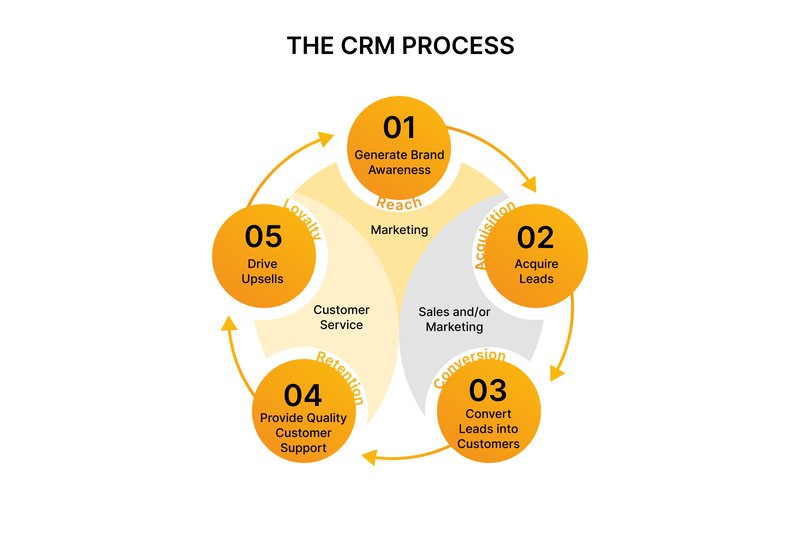
Similar to the customer lifecycle, the CRM process is a joint effort of marketing, sales, and customer support teams.
Let’s discuss each step in more detail and see how you can execute them to create an effective customer relationship management process.
1. Reach: Generate brand awareness
When you meet someone for the first time, you normally introduce yourself and tell them a bit about yourself. When reaching out to a potential client, you want to do the same.
This very first step in a CRM process is about attracting your prospect’s attention through specific marketing efforts and channels like social media or online advertisements. The marketing team approaches this stage by researching the target audience and creating personas. That is, creating a fictional profile of an ideal customer that includes details such as their individual background (age, gender, socio-economic status), geographical location, purchasing behavior, and interests.
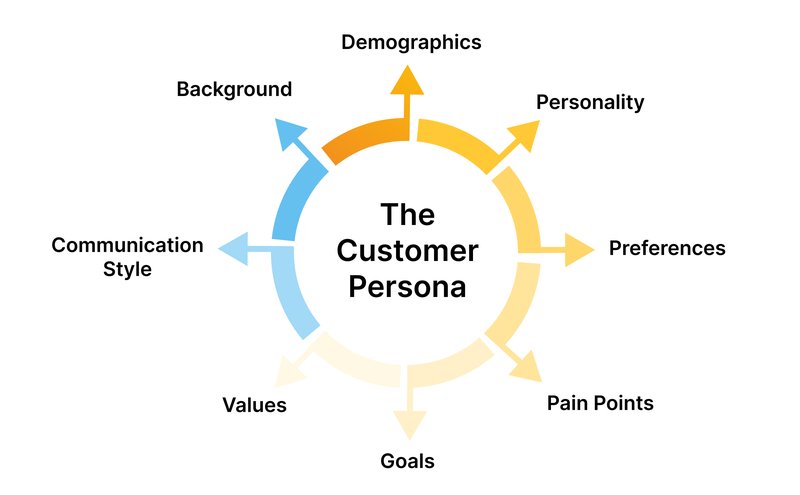
There are many useful insights customer research can bring. The more you know about your audience, the more tailored communication you can create to tell them about your brand.
If your audience consists of several personas, it is a good idea to segment them into groups. This way, you can tailor your marketing efforts to the specific segment’s preferences and interests. You can go one step further in learning more about your audience and launch A/B tests to find out which of your marketing campaigns works better for a specific segment.
At this stage, CRM software typically collects data about your past and current leads (e.g., browsing behavior, touchpoints, clicks, etc.). You will need it for customizing your marketing campaigns and starting to build relationships with your audience.
2. Acquisition: Acquire leads
After the introductory stage, it’s time to get to know each other better. Or, in a marketing context, acquire leads with the intention of converting them into paying customers. At this point, marketing and/or sales teams engage prospects through their preferred communication channels. Those could be social media posts, on-site lead-capturing methods (e.g., sign-up forms), live chat, or chatbots (standalone apps or as part of your CRM system).
Since you will be utilizing several channels of communication, try not to replicate your messages 1:1. You should remember that you leverage the omnichannel approach because of your audience's preferences. Therefore, the tone and copy of your messages should also be geared toward the specific persona. Whichever channels you will be using, make sure your communication is swift and on point.
Over the course of interactions with your audience, your leads will be producing a lot of informative data. Ideally, you want to store it in a CRM system and use it to improve your communication and touchpoints.
3. Conversion: Convert leads into customers
By now, you have managed to learn quite a bit about your customers — and the other way round; you know what they need, and they know what you can offer them. During the third stage of the customer relationship management process, you reap the rewards of the hard work you put into the previous stages. In other words, it’s time to convert your acquired leads into buyers.
However, the conversion doesn’t happen overnight. It is an effect of a combined effort of marketing and sales teams. Marketing converts leads through personalized content marketing and marketing automation. Whereas sales reps need to skillfully assess how hot or cold the lead is so they can focus more on those who are more likely to buy.
As for the cold leads, you continue nurturing them by maintaining regular and personalized communication. Although converting cold leads is much harder, you can still offer them content they would be interested in.
For example:
- Surveys
- eBooks
- Blog articles
- Email newsletters
- Webcasts and podcasts
- Product demos (live or videos)
- White papers, case studies, testimonials
Personalized content and communication are invaluable. According to research from Epsilon, 80% of buyers are more likely to make a purchase when brands offer personalized customer experiences. What else? Regular communication and valuable resources. These three factors combined will help you build trust, establish yourself as a knowledgeable and reliable partner, and keep your brand fresh in your leads’ memories.
4. Retention: Provide quality customer support
In the previous stage, you have hard-earned new buyers. Now, you don’t want your new relationships to end. Quite the opposite — you want to retain them and keep the relationships going.
And how do you do that? Through impeccable customer support, of course. According to Gartner, if customers have effortless customer service interactions, they are 94% more likely to buy the product or service again. There is also an 88% probability they would spend more.
So the bottom line is that customer support plays a huge role in customer retention. Not only will it help you prevent your customer base from shrinking, but also reduce the number of complaints going public (e.g., on social media). Not to mention that a bad word of mouth could cause your current customers to flee and the prospects to steer away from you.
So what really makes customer service impeccable? Apart from a professional approach, customers value prompt responses (52% expect a quick resolution), whether it is via social media, email, or phone. Another important factor is balancing reactive and proactive efforts. 54% of customer service leaders consider a shift from reactive to proactive service to be a key priority.
A proactive attitude helps to prevent issues before they happen and reduces the number of complaints customer service teams will need to deal with. You can introduce more proactive efforts into your organization with the latest tools, such as live chat, AI-powered chatbots, and self-help content (e.g., FAQ, tutorials, blog articles).
5. Loyalty: Drive upsells (and cross-sells)
Retaining customers and converting them into repeat buyers is one thing. Convincing them to spend more is yet another story. But this is what you actually want. The final stage of the customer relationship management process is about introducing your more expensive (or related) products/services to drive upsells and cross-sells.
Upselling is a sales strategy used to persuade existing customers to upgrade to a more advanced, feature-rich, or higher-priced version of the product or service they initially purchased. An example of an upsell would be suggesting that a customer upgrade their basic account to a premium subscription plan.
Cross-selling, on the other hand, aims to maximize the value of a single purchase by suggesting complementary products or services. For example, when someone buys a smartphone, a seller may offer a protective case and a warranty while the customer is still in the buying mindset.
A CRM system will come in extremely handy. It will reveal what your customers have bought in the past and group them based on their purchase history. It will allow you to create and send personalized email marketing campaigns featuring a selection of products your buyers are likely to be interested in.
You may also use this opportunity and reach out to ask about their experience with your product/service so far. Or, go beyond the direct up-/cross-selling and offer loyalty programs that give perks to certain customers.
Why is CRM important?
The process alone, coupled with the right CRM system, can truly help you improve the customer experience delivered by your company. And the best part is that this process can be applied by anyone, not only the enterprise businesses that can afford to buy or build a CRM system.
As a matter of fact, a CRM is an essential process for a freelancer, solopreneur, startup company, or large global corporation. Why? There are many reasons why a CRM process should matter for a business. Here’s what a CRM process can do for you:
- Promote a better understanding of your audience
- Enable more accurate segmentation
- Improve customer satisfaction and retention
- Encourages speedier communication
- Optimizes marketing efforts
- Maximizes business performance
Conclusion
By applying and following a proper CRM process, you can create a better customer experience at each stage of the customer lifecycle. The key to success is getting to know and understanding your audience well, anticipating their needs, and providing swift, top-class support.
CRM is a collaborative process; therefore, your support, sales, and marketing teams should work arm-in-arm to acquire and retain new buyers. Other key elements include a proper CRM system, as well as proactive support tools. If you want to make your service as personalized and frictionless as possible, Globaldev Group might be able to help you.