Agentic AI vs generative AI vs predictive AI: What's the difference?

The terms are often used interchangeably, even though they solve fundamentally different problems.
This confusion is understandable. Modern enterprise platforms frequently combine multiple types of AI within a single solution. A customer support platform may use large language models (LLMs) to generate responses, machine learning models to predict customer intent, and AI agents to automate follow-up actions.
Understanding the difference between AI types is becoming increasingly important as organizations invest more heavily in AI-powered transformation initiatives.
If you're looking for a simple explanation:
- Predictive AI forecasts what is likely to happen.
- Generative AI creates new content.
- Agentic AI plans, reasons, and executes actions to achieve a goal.
This distinction forms the foundation of the agentic AI vs generative AI vs predictive AI debate that many organizations are navigating today.
According to Gartner, 33% of enterprise software applications are expected to include agentic AI by 2028, up from less than 1% in 2024. Meanwhile, research from Deloitte shows that organizations continue to increase investments in generative AI while focusing on scaling pilots into production use cases.
The reality is that the future of AI will not belong to a single category. Instead, organizations will increasingly combine predictive systems, generative models, and agentic workflows to create intelligent business operations.
What are the main types of AI used in business today?
Most enterprise AI solutions fall into three categories:
- Predictive AI
- Generative AI
- Agentic AI
Although these technologies often work together, each serves a distinct purpose.
Organizations that understand these distinctions are far more likely to invest in the right AI solution and achieve measurable business outcomes.
What is predictive AI?
Predictive AI is a category of artificial intelligence that analyzes historical data to forecast future outcomes. Unlike generative AI, which creates content, or agentic AI, which takes actions, predictive systems focus on identifying patterns and estimating what is likely to happen next.
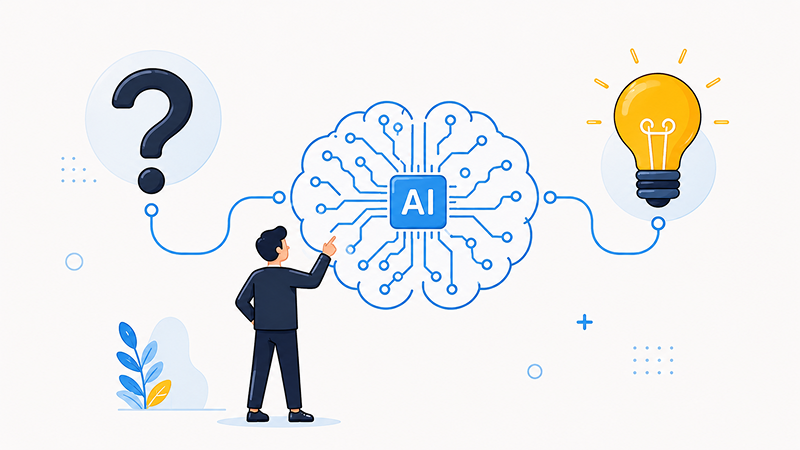
Predictive systems are commonly used to answer questions such as:
- Which customers are likely to churn?
- Which products will experience increased demand?
- Which transactions may be fraudulent?
- Which machines are likely to fail?
The foundation of predictive AI lies in machine learning models trained on historical information.
How predictive AI works
The process begins with AI model training. Historical data is collected and used to teach algorithms how to recognize patterns and relationships.
Typical data sources include:
- Customer behavior
- Financial transactions
- Operational metrics
- Sensor readings
- Market trends
After training, the resulting forecasting models can estimate future outcomes based on newly received data. This capability forms the basis of modern forecasting and decision-support systems.
Predictive analytics vs machine learning
Many professionals confuse predictive analytics vs machine learning, but the two are not identical. Machine learning refers to the technology that enables systems to learn from data. Predictive analytics is a business application of machine learning focused specifically on forecasting future events.
In simple terms:
- Machine learning is a technology.
- Predictive analytics is one of its applications.
This distinction is important when comparing LLM vs predictive model difference because predictive systems are optimized for forecasting rather than content creation.
Predictive AI use cases in business
Today, some of the most valuable predictive AI use cases in business include:
- Demand forecasting
- Fraud detection
- Predictive maintenance
- Revenue forecasting
- Customer churn prediction
- Credit risk analysis
- Healthcare forecasting
- Supply chain optimization
Many organizations rely on predictive systems because they provide measurable, data-driven insights that improve strategic planning.
Real-world example: Predictive AI in the utility industry
One of the strongest examples of predictive AI implementation comes from Globaldev's collaboration with Gentrack.
As smart metering adoption accelerated across utility providers, organizations began generating enormous volumes of operational and customer data. However, much of that information remained difficult to analyze because it was distributed across multiple systems.
To solve this challenge, Globaldev partnered with Gentrack to build the Gentrack Logical Data Model (GLDM), a centralized analytics layer that provides a unified view of utility operations. The platform enables organizations to process large volumes of customer and operational information while supporting advanced AI initiatives.
The solution incorporates AI-powered forecasting and anomaly detection capabilities that leverage historical utility data to identify trends, predict future performance, and highlight unusual operational patterns. Native AI and machine learning functionality within Snowflake enables anomaly detection directly within the data layer, helping organizations surface irregularities without relying on external analytics platforms.
The platform also integrates natural language processing (NLP) capabilities within Power BI, allowing business users to ask questions in plain language and automatically generate relevant reports and visualizations.
This project demonstrates how predictive AI, real-time data processing, and advanced analytics can help enterprises transform large datasets into actionable business insights.
For more details, read the case study.
What is generative AI?
Generative AI refers to artificial intelligence systems capable of creating entirely new content. Unlike predictive systems that forecast outcomes, generative systems produce outputs such as:
- Text
- Code
- Images
- Audio
- Video
- Documents
The widespread popularity of ChatGPT / GPT-4o introduced generative AI to mainstream audiences, but the underlying technologies have been under development for years.
How generative AI works
At a high level, generative AI learns patterns from massive datasets and uses those patterns to create new content that resembles human-created outputs.
The process typically involves three stages:
- Training: AI models are trained on large volumes of text, images, code, audio, or other data. During this stage, the system learns relationships between words, concepts, patterns, and structures.
- Inference: When a user submits a prompt, the model analyzes the input and predicts the most relevant output based on the knowledge acquired during training.
- Generation: The model produces new content, whether it is a written response, a software code snippet, an image, a summary, or another form of output.
Most modern generative AI systems rely on deep learning and transformer models, which allow them to process large amounts of information and understand context more effectively than previous AI architectures.
For example, when a user asks ChatGPT to write a blog post, the model does not retrieve a pre-written article from a database. Instead, it generates a new response in real time by predicting the most likely sequence of words based on the prompt and its training data.
This ability to create original outputs is what distinguishes generative AI from predictive AI, which focuses on forecasting outcomes rather than generating new content.
The role of large language models (LLMs)
Modern generative systems rely heavily on large language models (LLMs). Examples include:
- ChatGPT / GPT-4o
- Claude (Anthropic)
- Gemini (Google DeepMind)
- Perplexity AI
These systems are powered by transformer models, a breakthrough architecture in deep learning that enables advanced natural language processing (NLP).
Instead of retrieving predefined answers, these models predict the most likely sequence of words based on context and training data. This capability allows them to generate human-like responses, summaries, code, recommendations, and other forms of content.
Real-world example: Generative AI in healthcare
A practical example of generative AI implementation can be found in Globaldev's work with eHealthy, a healthcare platform designed to connect patients, physicians, consultants, and medical facilities through a unified digital ecosystem.
One of the platform's most innovative features is an AI-powered physician recommendation engine. Rather than forcing patients to navigate complex filters and healthcare directories, the system allows users to describe symptoms, medical concerns, scheduling preferences, or healthcare needs using natural language. The AI then interprets the request and identifies the most suitable physicians and appointment options.
The recommendation system leverages advanced language understanding capabilities similar to those found in modern large language models (LLMs). By interpreting patient intent instead of relying solely on keywords, the platform improves accessibility while reducing administrative friction.
This project demonstrates how content generation AI, natural language processing (NLP), and language understanding technologies can improve customer experiences in highly regulated industries such as healthcare.
For more details, read the case study.
Is ChatGPT generative or agentic AI?
ChatGPT is primarily a generative AI system. Its primary purpose is generating content, including:
- Text
- Code
- Summaries
- Explanations
- Recommendations
Systems such as ChatGPT / GPT-4o, Claude (Anthropic), and Gemini (Google DeepMind) are fundamentally designed to generate outputs based on prompts. However, the confusion arises because modern AI assistants increasingly integrate external tools, memory, APIs, and workflow systems.
When connected to business applications, a generative model can become part of a larger agentic AI architecture.
For example:
- ChatGPT generates instructions.
- An AI agent executes those instructions.
- External tools perform actions.
- Results are returned to the user.
This is why many organizations mistakenly assume ChatGPT itself is agentic.
In reality:
- ChatGPT = primarily generative AI
- AutoGPT = agentic framework
- Devin = agentic system
- Amazon Bedrock Agents = agentic platform
Understanding this distinction is critical when evaluating enterprise AI investments.
What is agentic AI?
Agentic AI represents the next evolution of artificial intelligence. Unlike predictive systems that forecast outcomes or generative systems that create content, agentic systems are designed to pursue goals and execute actions.
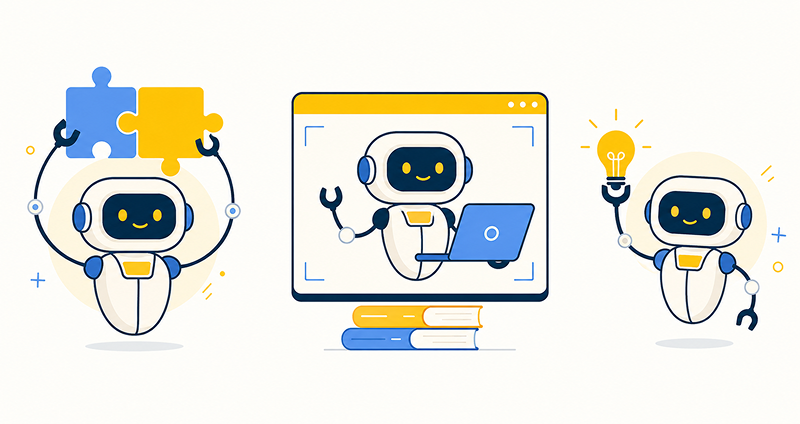
These systems are commonly referred to as AI agents or autonomous AI systems because they can perform tasks with varying degrees of independence. Their objective is not merely answering questions. Their objective is completing work.
How agentic AI works
Understanding how agentic AI works requires understanding its operational cycle.
Most agentic systems follow a structured process:
- Receive a goal
- Analyze requirements
- Build a plan
- Gather information
- Select tools
- Execute actions
- Evaluate results
- Refine the strategy
This process enables goal-directed behavior, allowing the system to adapt dynamically as circumstances change.
For example, if an AI agent receives a goal such as: "Generate a competitive market analysis and schedule a review meeting."
It may:
- Collect market data
- Analyze competitors
- Generate reports
- Create presentations
- Schedule meetings
- Send notifications
All within a single workflow.
AI planning and reasoning with agentic AI
The defining capability of agentic systems is AI planning and reasoning. Traditional automation follows predefined rules. Agentic systems dynamically decide:
- Which action to perform
- Which tool to use
- Which information is missing
- Which workflow path is most effective
This enables advanced decision-making AI and sophisticated AI workflow automation.
Agentic AI examples 2026
Some of the most frequently cited agentic AI examples 2026 include:
- AutoGPT
- Devin (Cognition)
- Amazon Bedrock Agents
- Solutions powered by MCP (Model Context Protocol)
These platforms represent a shift from conversational AI toward autonomous execution.
Real-world example: Agentic-style automation with Chatmantics
While fully autonomous agents remain an emerging technology, many organizations already use systems that exhibit agent-like characteristics.
One example is Chatmantics, a conversational automation platform supported by Globaldev. The platform handles more than 250,000 inbound customer interactions every month across channels including voice, SMS, Facebook, and other communication platforms. AI-powered virtual assistants help businesses qualify leads, answer routine questions, and escalate complex issues to human representatives.
What makes this example particularly relevant is its ability to automate processes across multiple systems. The platform integrates with CRMs, marketing platforms, and internal business tools, allowing automated workflows to extend beyond simple chatbot interactions.
Although Chatmantics is not a fully autonomous agentic platform, it illustrates the evolution toward systems capable of multi-step task execution, workflow orchestration, and intelligent business process automation.
This type of architecture forms the foundation of many modern enterprise AI agents.
For more details, read the case study.
Can agentic AI replace human decision-making?
A growing number of business leaders ask: Can agentic AI replace human decision-making? For most organizations, the answer is no.
Agentic systems can automate many operational processes, but they still face significant limitations:
- Incomplete information
- Context gaps
- Regulatory requirements
- Ethical considerations
- Accountability concerns
- AI hallucinations
This is why enterprise implementations typically include a human-in-the-loop approach.
Rather than replacing employees, agentic systems augment human teams by automating repetitive work while escalating complex decisions for review.
The most successful deployments combine AI autonomy with human oversight.
Agentic AI vs generative AI
The comparison between agentic AI vs generative AI has become one of the most discussed topics in enterprise technology. Although both technologies may rely on large language models (LLMs), they serve different purposes.
What is the difference between agentic and generative AI?
Generative AI creates. Agentic AI acts. Generative systems focus on producing outputs. Agentic systems focus on achieving outcomes.
In practice, many modern solutions combine both capabilities.
Generative AI vs predictive AI
The discussion around generative AI vs predictive AI often stems from the fact that both technologies rely on artificial intelligence and machine learning.
However, they address completely different business objectives.
When to use predictive AI vs generative AI
Organizations should choose predictive AI vs generative AI based on their business goals.
Use predictive AI when you need:
- Demand forecasting
- Fraud detection
- Risk analysis
- Churn prediction
- Operational forecasting
Use generative AI when you need:
- Content creation
- Customer communication
- Knowledge assistants
- Software development support
This distinction is at the heart of many generative AI vs predictive AI business use cases.
LLM vs predictive model difference
A common misconception is that all AI systems function similarly. The LLM vs predictive model difference is significant: Predictive models estimate future outcomes, while LLMs generate new content.
A forecasting model might predict next month's revenue. A language model might generate a report explaining that forecast.
Both are valuable but serve different purposes.
Why do modern businesses rarely choose just one AI type?
The reality is that modern enterprise platforms increasingly combine multiple AI capabilities. Organizations rarely deploy predictive, generative, or agentic technologies in isolation.
Instead, they build intelligent systems that leverage the strengths of each approach.
Real-world example: Yaballe's hybrid AI strategy
Yaballe, an eCommerce automation platform, provides an excellent example of this trend.
The platform helps online merchants automate marketplace operations such as product listing management, inventory synchronization, and order processing. Globaldev supported Yaballe's evolution toward a more scalable and user-centric ecosystem.
As part of this transformation, Yaballe introduced AI-driven capabilities that combine multiple AI approaches.
The platform uses generative AI to automatically create product titles and descriptions, helping merchants save time while maintaining consistency across listings. At the same time, predictive analytics models evaluate product demand and sales potential, helping sellers make more informed sourcing and pricing decisions.
This demonstrates how organizations increasingly blend generative AI vs predictive AI capabilities rather than choosing one over the other.
The next stage of this evolution is the integration of agentic AI, allowing systems to not only generate insights but also take action on them.
For more details, read the case study.
Agentic AI vs generative AI vs predictive AI for enterprise
When evaluating agentic AI vs generative AI for enterprise, organizations should focus on business outcomes rather than technology trends.
Use predictive AI when you need:
- Forecasting
- Risk management
- Demand planning
- Operational optimization
- Revenue prediction
Use generative AI when you need:
- Content creation
- Customer support
- Knowledge management
- Coding assistance
- Research summarization
Use agentic AI when you need:
- Workflow automation
- Process orchestration
- Autonomous execution
- Decision support
- Complex business operations
Many enterprises are now combining all three capabilities within a single ecosystem.
Examples include platforms from:
- Salesforce Einstein
- IBM Watson
- Google Analytics (predictive)
- OpenAI ecosystem
- Anthropic ecosystem
This convergence is likely to define the next generation of enterprise software.
What’s better: Hire agentic AI developers or work with a generative AI development company?
As organizations move beyond experimentation, implementation becomes the biggest challenge.
Building successful AI solutions requires expertise in:
- Data engineering
- Model development
- Infrastructure
- Security
- Governance
- Enterprise integrations
Whether you're looking for a generative AI development company or need to hire agentic AI developers, success depends on selecting the right technology for the problem you're trying to solve.
Organizations exploring agentic AI for software development, intelligent assistants, or enterprise AI automation initiatives must also consider:
- Data quality
- Security requirements
- Compliance obligations
- Human oversight
- Long-term maintenance
The most successful projects combine technical expertise with a clear business strategy.
Conclusion
The future of enterprise AI is not about choosing between agentic AI vs generative AI vs predictive AI. Instead, the most successful organizations will combine all three:
- Predictive AI identifies opportunities and forecasts outcomes.
- Generative AI creates content, recommendations, and insights.
- Agentic AI transforms those insights into action through intelligent execution.
As AI enterprise adoption continues accelerating, organizations that understand the strengths and limitations of each approach will be better positioned to build scalable, practical, and measurable AI solutions.
The question is no longer which AI type will dominate the future. The question is how effectively businesses can combine predictive intelligence, generative capabilities, and autonomous execution into a unified strategy.
If you're exploring how predictive AI, generative AI, or agentic AI can support your business objectives, Globaldev can help. From AI strategy and data readiness assessments to full-scale development and deployment, our team helps companies turn AI initiatives into practical, scalable solutions. Ready to build your next AI-powered product or workflow? Let's talk.