AI skills gap: Why enterprises need an AI implementation partner, not just a model

The challenge goes beyond finding enough AI engineers. Enterprises need the combined capabilities to identify valuable use cases, prepare data, design architecture, integrate AI with existing systems, establish governance, manage security and risk, redesign workflows, support adoption, and measure business outcomes.
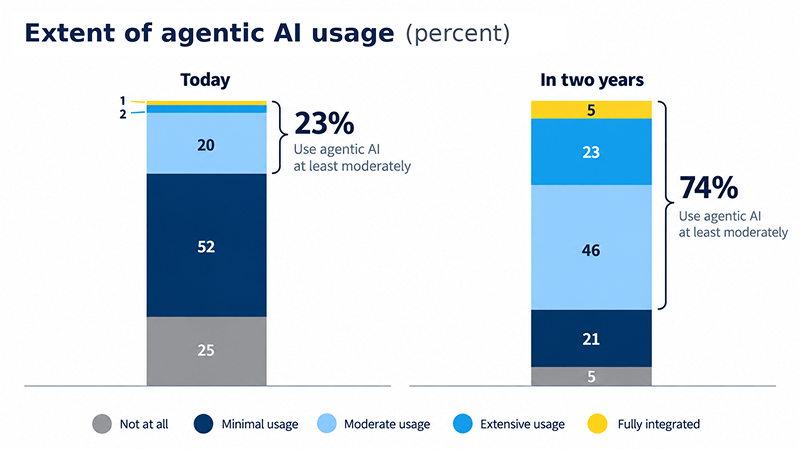
Source: deloitte.com
This is where the distinction between having access to AI and being ready to implement it becomes critical.
An AI implementation partner can help bridge capability gaps across business strategy, AI expertise, software engineering, data, architecture, governance, and change management. The objective is not simply to deploy another AI tool, but to create the conditions in which AI can deliver sustainable business value.
Is there an AI skills gap in the workforce?
Yes, but the AI skills gap is broader than a shortage of people who know how to use AI tools.
The World Economic Forum's Future of Jobs Report 2025, based on input from more than 1,000 employers, found that 63% identify skills gaps as a major barrier to business transformation. Employers also expect 39% of workers' existing skill sets to change or become outdated between 2025 and 2030, with AI and big data ranking among the fastest-growing skill areas.
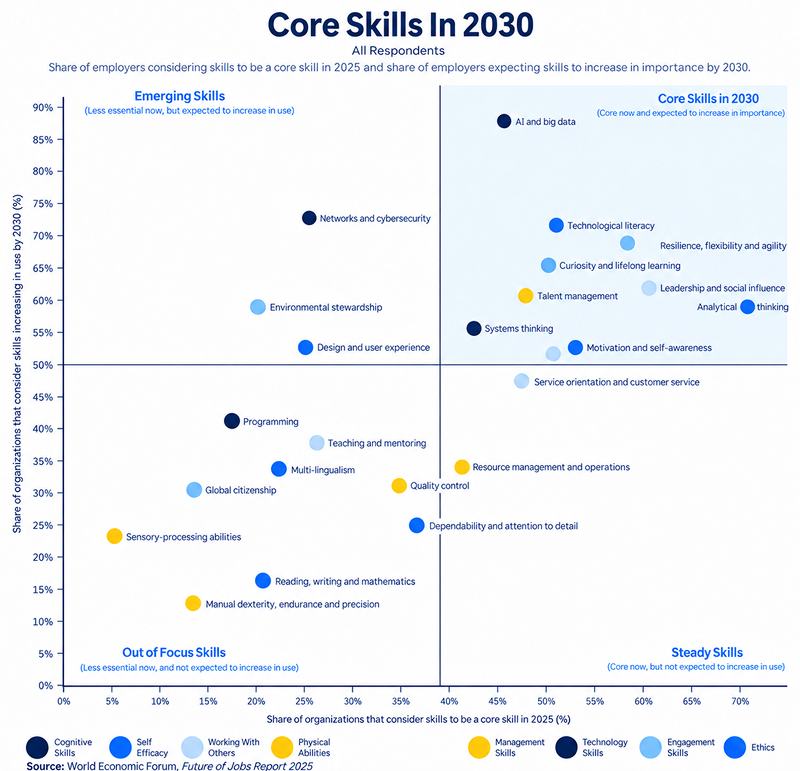
Source: weforum.org
The problem is particularly relevant to enterprise AI adoption because implementing AI requires several types of expertise to work together.
An enterprise may need AI and LLM engineering expertise, but it also needs people who understand data architecture, system integration, security, compliance, business processes, AI governance, user adoption, and organizational change management. Employees and leaders need sufficient AI fluency to understand what the technology can and cannot do, where human oversight is required, and how workflows should change.
This makes the AI talent shortage a multidimensional problem rather than simply a recruiting problem.
The AI skills gap is also changing
The capabilities enterprises need are evolving alongside AI itself.
A few years ago, enterprise AI expertise might have centered on machine learning, data science, and model development. Generative AI enterprise adoption added new requirements around LLMs, retrieval-augmented generation (RAG), prompt engineering, evaluation, context management, and model integration.
Now, agentic AI enterprise adoption is expanding those capability requirements again. Organizations must think about how agents interact with enterprise systems, what permissions they receive, how actions are monitored, where humans remain in the loop, and how autonomous systems are governed.
Deloitte reports that only one in five organizations surveyed currently has a mature governance model for autonomous AI agents.
Closing the AI skills gap therefore does not mean reaching a fixed destination. Enterprises need the capacity to continuously develop skills and adapt their operating practices as AI capabilities evolve.
This explains why reskilling / upskilling has become central to AI strategy. The World Economic Forum reports that 77% of surveyed employers plan to reskill and upskill their existing workforce to work more effectively alongside AI by 2030.
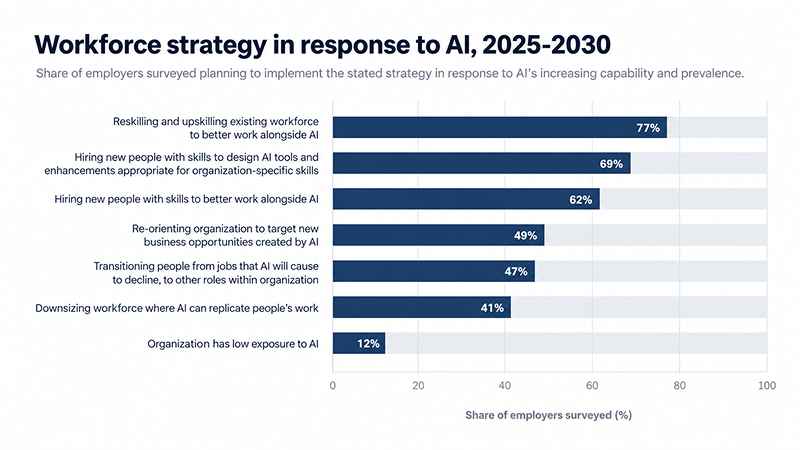
Source: weforum.org
Why enterprise AI adoption is struggling even as models get better
The availability of more capable models can make it tempting to treat enterprise AI adoption primarily as a technology decision.
Which model should we use? — That question matters, but it comes too early if an organization has not established what it wants AI to accomplish.
A model does not determine which business processes should change. It does not decide whether enterprise data is ready. It does not establish governance, redesign workflows, define ownership, integrate itself safely with business-critical systems, or determine how ROI should be measured.
That is the difference between model access and AI readiness.
Recent research illustrates this distinction.
McKinsey's 2026 research on AI transformation found a significant gap between individual and organizational readiness. In its survey, 70% of respondents said they felt personally prepared to adopt and use AI, while only 27% of leaders believed their organizations were ready to make the changes required for an agentic future.
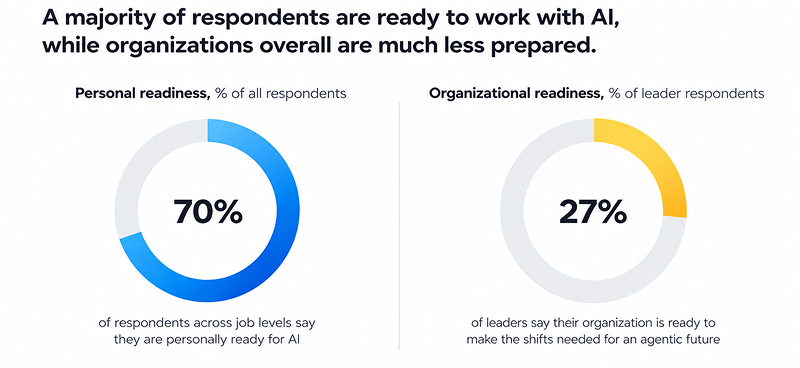
Source: mckinsey.com
The same research found that organizational readiness was more strongly associated with reported enterprise value than individual readiness. In other words, employees becoming proficient AI users does not by itself turn an organization into an AI-enabled enterprise.
This is one of the fundamental enterprise AI adoption challenges: individual experimentation can happen quickly, while transforming processes, systems, data, governance, and organizational practices takes considerably more work.
Why model access alone isn't enough to close the AI skills gap
There is an apparent contradiction in the conversation about AI and workforce skills.
On one hand, enterprises face an AI skills gap. On the other, AI itself can help people perform tasks that previously required more specialized expertise.
So, how can AI solve the skills gap?
AI can narrow parts of it. It can accelerate learning, support software development, assist with research and analysis, automate repetitive work, and make specialist knowledge more accessible to employees.
But it cannot eliminate the organizational capabilities required to implement it responsibly and effectively.
Consider what happens when an enterprise purchases access to a leading AI model.
The model can be available immediately. Yet the organization still needs to determine:
- which use cases justify investment;
- what data those use cases require;
- whether that data is sufficiently reliable and accessible;
- how AI should integrate with existing applications and infrastructure;
- what security and privacy requirements apply;
- when human-in-the-loop review is required;
- which teams own AI systems and their outputs;
- how employees should use the new capabilities;
- how results should be evaluated;
- and whether the initiative is producing measurable value.
This is why AI can simultaneously help address the skills gap and create demand for new skills.
As models become easier to access, the differentiator increasingly shifts from having AI to knowing where, how, and under what conditions to use it.
Agentic AI enterprise adoption raises the stakes further
The distinction becomes even more important with agentic AI enterprise adoption.
A chatbot generating a draft for human review presents one level of operational risk. An AI agent accessing internal systems, retrieving sensitive data, invoking tools, updating records, or initiating actions presents another.
This requires organizations to consider permissions, identity and access management, monitoring, escalation rules, evaluation, auditability, and human oversight as part of the implementation architecture.
The more AI can do, the more important implementation capability becomes.
Why AI projects fail: The implementation gap
There is no single failure rate that accurately represents all AI projects. Statistics frequently repeated online, such as claims that 85% of AI projects fail, often combine different technologies, time periods, definitions of failure, and project stages.
More useful evidence focuses on why initiatives stall.
In January 2026, Gartner reported that at least 50% of generative AI projects had been abandoned after proof of concept (PoC) by the end of 2025. The reasons included poor data quality, inadequate risk controls, escalating costs, and unclear business value.
Those reasons point to an important conclusion: why do most enterprise AI projects fail often has less to do with whether the underlying model works and more to do with the environment surrounding its implementation.
1. The business case is unclear
Starting with "we need AI" rather than a specific business problem often produces technically interesting projects with uncertain commercial value.
A successful initiative should begin with questions such as:
What problem are we solving? Who benefits? What changes if the solution works? How will that improvement be measured?
Clear success criteria also make it easier to compare potential use cases and direct investment toward opportunities with realistic business value.
2. Data is not ready
Data readiness is one of the foundations of enterprise AI.
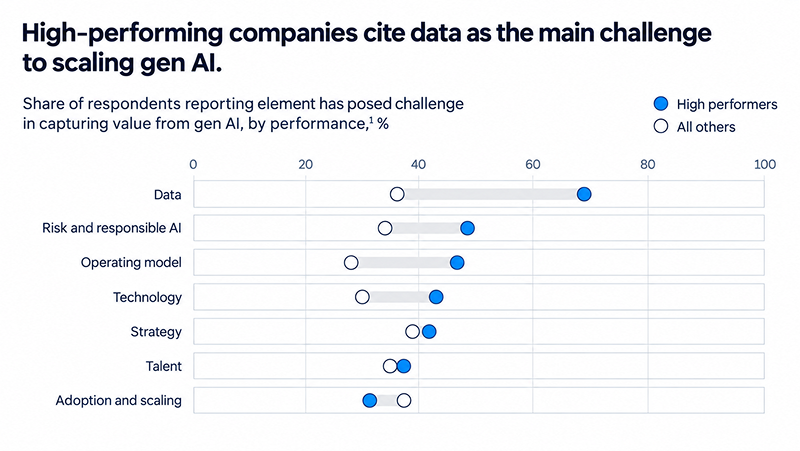
AI systems may need access to internal documents, product information, customer data, operational records, policies, or knowledge bases. If that information is incomplete, inconsistent, inaccessible, poorly governed, or outdated, adding a more capable model does not necessarily solve the problem.
McKinsey reported in 2026 that more than two-thirds of high-performing companies in its research identified data as the primary obstacle to enabling AI.
Source: mckinsey.com
This does not mean organizations need "perfect data" before starting. They need to understand what level of quality, accessibility, traceability, and governance is required for each use case.
3. The project gets stuck at proof of concept (PoC)
A proof of concept (PoC) answers an important but limited question: Can this idea work?
Production implementation requires answering many more: Can it work reliably? Can it scale? Is it secure? How much will it cost? How does it integrate with existing systems? Who monitors it? What happens when it produces an incorrect result?
A compelling demo is therefore not the same as a production-ready AI system.
4. Architecture and integration are underestimated
Enterprise AI rarely operates in isolation. It may need to communicate with CRMs, ERPs, knowledge bases, data platforms, communication systems, APIs, internal applications, and third-party services.
Organizations also need to decide where techniques such as RAG, tool use, model fine-tuning, orchestration, or agent-based architectures are appropriate. These decisions affect cost, performance, maintainability, security, and scalability.
5. AI governance and security arrive too late
AI governance should not be something added immediately before production. Organizations need policies and technical controls covering issues such as data access, privacy, security, intellectual property, model usage, human oversight, output validation, accountability, and monitoring.
This becomes increasingly important as AI systems move from generating information to taking actions.
6. There is no clear ownership
AI initiatives cut across traditional organizational boundaries.
Business teams understand the process. Engineering understands systems. Data teams understand information infrastructure. Security and legal teams understand risk. Leadership controls priorities and investment.
Successful implementation requires those perspectives to converge around clear decision rights and accountability.
That is why the question why do AI projects fail because of talent gap is better understood as a capability problem than simply a shortage of AI developers.
What is an AI implementation partner?
An AI implementation partner is an external team that helps an organization move from AI strategy and experimentation to operational deployment and scaling. Depending on the engagement, this can include AI readiness assessment, use-case prioritization, architecture, data preparation, integration, governance, implementation, workforce enablement, and ongoing optimization.
An enterprise AI implementation partner therefore operates at the intersection of business and technology.
A useful way to think about the role is: Assess → Prioritize → Design → Implement → Govern → Adopt → Measure → Improve
- Assess: Understand current AI maturity, business processes, systems, data, skills, security, and organizational readiness.
- Prioritize: Identify use cases and determine which opportunities offer sufficient business value and implementation feasibility.
- Design: Define the architecture, integrations, data requirements, models, governance controls, and implementation approach.
- Implement: Build and integrate the solution into real enterprise systems and workflows.
- Govern: Establish controls around data, security, permissions, risk, oversight, and accountability.
- Adopt: Prepare employees, redesign workflows, provide training, and support change management.
- Measure: Track business and technical KPIs rather than treating deployment itself as success.
- Improve: Refine systems, workflows, governance, and organizational capabilities as usage and AI technology evolve.
For larger organizations, an implementation partner can also support the development of an AI center of excellence or another internal operating model that establishes reusable practices and ownership across AI initiatives.
AI implementation partner vs consultant vs in-house team
The terms are sometimes used interchangeably, and there is no universal industry definition. In practice, the distinction is usually about the scope of responsibility.
An AI implementation partner vs consultant comparison should therefore not be interpreted as "implementation partner good, consultant bad." A consultancy may be the right choice when the organization primarily needs strategy, research, or independent advice. An implementation partner becomes particularly relevant when the organization needs to connect strategic decisions directly to architecture, engineering, integration, deployment, and adoption.
An in-house team provides long-term ownership and domain knowledge. However, organizations do not necessarily need to choose between internal expertise and an external partner. A partner can supplement capabilities that are currently missing while helping the internal team develop them.
How to assess AI readiness before deciding what to implement
A structured AI readiness assessment helps an organization understand the gap between its AI ambitions and its current ability to execute them.
What is an AI readiness assessment? It is a systematic evaluation of whether an organization has the business, data, technology, governance, security, skills, and operating capabilities required to implement AI effectively.
A practical AI readiness assessment framework should examine at least the following areas.
1. Current AI adoption and maturity
Where is AI already being used? Which tools and models are employees using? Are initiatives centrally managed or emerging independently across departments?
Understanding the current state helps uncover both existing capabilities and unmanaged risks.
2. Business objectives and use cases
AI initiatives should connect to business problems rather than begin with technology.
Potential use cases can be evaluated according to expected value, technical feasibility, data availability, risk, cost, implementation complexity, and organizational impact.
3. Data readiness
Determine what data each use case requires and assess its availability, accessibility, quality, ownership, security, and governance.
4. Architecture and integrations
Evaluate whether existing infrastructure can support the proposed solution and identify the applications, APIs, data platforms, models, and external systems involved.
5. Security, compliance, and AI governance
Identify relevant security controls, privacy obligations, regulatory requirements, access rules, validation requirements, and human-in-the-loop mechanisms.
6. Skills and organizational readiness
Determine who will design, build, manage, use, monitor, and improve AI systems. This assessment should include both specialist capabilities and broader AI literacy.
7. Economics and measurable value
Estimate implementation and operating costs alongside expected business benefits. Success metrics should be established before implementation wherever possible.
8. Implementation roadmap
Finally, convert the findings into a prioritized roadmap defining initiatives, dependencies, responsibilities, implementation stages, and measurable outcomes.
Globaldev's AI Readiness Assessment & Implementation Strategy follows this broader assessment-to-roadmap approach, helping organizations evaluate where they stand today, identify valuable AI opportunities, and define a practical path toward implementation.
How an AI implementation partner helps close the AI skills gap
Hiring remains part of the answer to the AI talent shortage, but hiring alone is unlikely to solve every capability gap, particularly when the technologies and required skills continue to change.
An AI implementation partner can address the problem differently.
Access specialized capabilities without building every role internally
A project may require business analysis, AI architecture, AI engineering, software engineering, data expertise, DevOps, security, QA, governance, and project management.
Not every organization needs, or can immediately build, permanent internal teams covering all these capabilities.
A partner can bring the required specialists together around the initiative while internal teams retain business knowledge and long-term ownership.
Transfer knowledge instead of creating permanent dependency
An effective implementation partnership should leave the organization more capable than it was at the beginning.
Documentation, training, reusable implementation patterns, governance standards, workshops, and hands-on collaboration can transfer knowledge to internal teams.
This turns reskilling / upskilling into part of implementation rather than a separate activity.
Establish repeatable AI practices
If every department experiments independently, enterprises can end up with duplicated tools, inconsistent security practices, incompatible architectures, and fragmented knowledge.
Reusable standards can cover model selection, architecture, data access, evaluation, security, development, deployment, monitoring, and AI governance.
These practices can eventually form the foundation of an AI center of excellence or another centralized AI operating model.
Connect adoption to organizational change
The strongest enterprise AI adoption best practices extend beyond teaching employees how to prompt a model.
McKinsey's 2026 research found that leaders in its earliest AI transformation horizon were 5.3 times more likely to report enterprise value capture when workflows were redesigned rather than left unchanged.
That finding highlights why change management matters. Organizations need to determine how AI changes processes, responsibilities, decision-making, and collaboration, not simply whether employees know how to use it.
How to choose an AI implementation partner
Knowing how to choose an AI implementation partner starts with evaluating whether a provider can connect business objectives with production implementation rather than focusing on AI technology in isolation.
Consider asking:
- Do they start with business problems or technology? A credible partner should be able to explain how use cases will be identified, evaluated, and prioritized.
- Can they assess readiness before recommending implementation? Look for an approach covering business goals, data, architecture, security, governance, skills, and organizational readiness.
- Do they have production engineering capabilities? A prototype is different from an enterprise system. Examine experience in software engineering, architecture, integrations, cloud infrastructure, testing, DevOps, and long-term support.
- How do they approach data and security? The partner should be able to explain how data will be accessed, governed, protected, and monitored.
- Are they tied unnecessarily to one model or technology? Model choice should follow use-case requirements, existing infrastructure, security constraints, performance needs, and economics.
- How do they approach AI governance? Ask about human oversight, permissions, monitoring, evaluation, security, and accountability.
- Do they support knowledge transfer? Implementation should develop internal capability rather than make the organization permanently dependent on external specialists.
- How do they define success? Look for measurable business and operational outcomes rather than AI deployment itself.
- Can they support implementation after strategy? If your goal extends beyond developing a roadmap, determine who will actually design, build, integrate, test, and deploy the solutions.
- Can they help establish reusable capabilities? Successful projects should ideally create patterns, standards, knowledge, and infrastructure that make subsequent AI initiatives easier to implement.
The answer to how do I choose an AI implementation partner? ultimately depends on the capability gap you need to close. Some organizations need technical implementation capacity; others need help deciding what to implement in the first place. Many need both.
Closing the AI skills gap requires more than hiring
The AI skills gap is real, but treating it exclusively as a hiring problem misses the larger challenge.
Enterprises increasingly have access to many of the same models and AI platforms. Competitive differentiation therefore depends less on access alone and more on an organization's ability to apply those technologies to the right problems, integrate them into real workflows, govern them responsibly, and continuously improve how people and AI work together.
That requires three elements to develop in parallel: Technology + organizational capability + implementation discipline.
An enterprise AI implementation partner can provide missing expertise while helping an organization build the architecture, processes, skills, governance, and internal capabilities required for sustainable enterprise AI adoption.
For organizations that are still determining where they stand, an AI readiness assessment can provide the starting point.
Globaldev helps organizations assess their current AI maturity, identify and prioritize use cases, evaluate technical and organizational readiness, and turn those findings into an actionable implementation roadmap.
The objective is not to implement AI everywhere. It is to understand where AI can create meaningful value, what needs to be in place to capture it, and how to move from experimentation to implementation with a clear plan.