That is why a Claude vs ChatGPT vs Gemini comparison cannot be reduced to asking which model produces the best response to the same prompt.
For businesses, the more useful question is: which AI model is best for the specific use case, technical environment, security requirements, existing tools, budget, and implementation strategy?
This distinction is becoming particularly important as differences between leading models become less clear-cut. The Stanford AI Index 2026 documents increasingly competitive performance among leading model developers while also showing how quickly frontier AI capabilities continue to evolve.
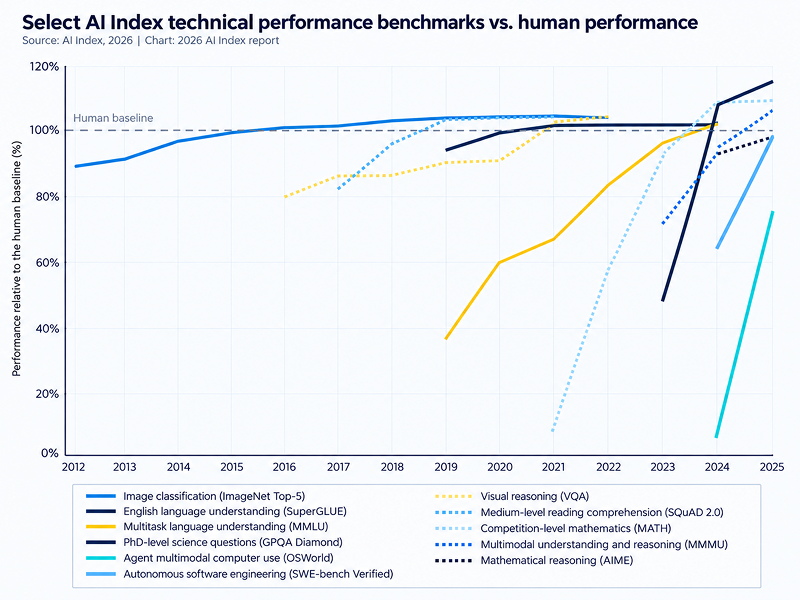
Source: Arena, 2026
A proper AI model comparison therefore needs to look beyond model benchmarks and consider the complete environment in which AI will operate.
The same applies when comparing ChatGPT vs Claude vs Gemini, Claude vs Gemini vs ChatGPT, or Gemini vs Claude vs ChatGPT: there is no universal answer that applies to every organization.
Claude vs. ChatGPT vs. Gemini at a glance
Claude is developed by Anthropic, ChatGPT by OpenAI, and Gemini by Google. Each company now offers much more than a standalone conversational interface, with business products, developer platforms, integrations, agentic capabilities, and enterprise controls forming broader AI ecosystems.
Here is a high-level enterprise LLM comparison:
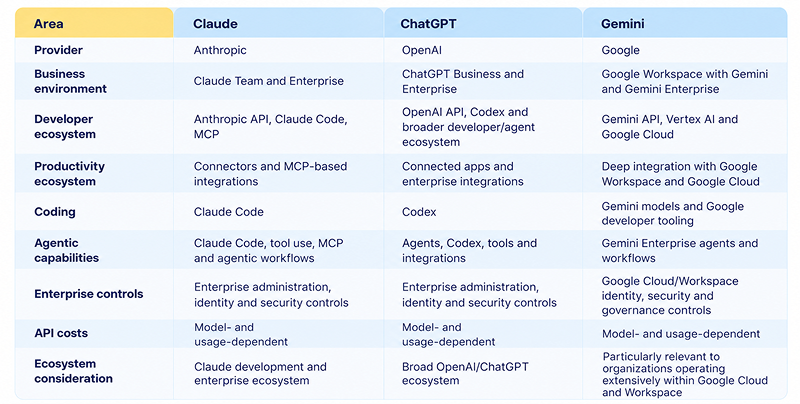
Particularly relevant to organizations operating extensively within Google Cloud and Workspace
These are broad characteristics rather than a ranking. Individual capabilities vary by model, plan, region, configuration, and product release and can change quickly.
The important point is that the products are no longer directly comparable on subscription price or model benchmarks alone.
What sets Claude, ChatGPT, and Gemini apart?
The differences between these platforms become clearer when they are viewed as ecosystems rather than individual models.
Claude: Anthropic's AI ecosystem for business
For companies evaluating Claude for business, Anthropic offers a combination of Claude's conversational environment, APIs, Claude Code, enterprise capabilities, connectors, and Model Context Protocol integrations.
One characteristic of the Claude ecosystem is its support for context-heavy work. The exact context window varies by model and product configuration, which is why businesses should verify current specifications when evaluating Claude for document-heavy workflows, large codebases, or other applications requiring substantial context.
Claude Code extends the ecosystem into software engineering. It can work with codebases and development tools, while MCP (Model Context Protocol) provides a standardized way for AI applications to connect with external data sources, tools, and services.
For organizations, however, model capability is only part of the equation. Enterprise deployment also requires evaluating identity and access management, data policies, retention, auditability, integrations, governance, and the controls available under the intended Claude plan.
ChatGPT: OpenAI's business AI ecosystem
ChatGPT for business has similarly expanded well beyond conversational AI.
OpenAI's business environment combines ChatGPT with capabilities for research, coding, data analysis, company knowledge, connected applications, agents, and other types of work. Its business products can connect with commonly used enterprise services and provide administrative controls for organizational deployment.
For development, Codex provides coding capabilities within the wider OpenAI ecosystem. For broader business workflows, OpenAI has also expanded agentic functionality and integrations that allow AI to work with applications and organizational information.
ChatGPT Enterprise adds additional administration, security, deployment, and organizational controls. OpenAI states that business data from ChatGPT Business, ChatGPT Enterprise, and its API platform is not used to train its models by default.
That means a Claude AI vs ChatGPT for business decision needs to account for much more than which chatbot produces the preferred response.
Gemini: Google's business AI ecosystem
Gemini for business has a different ecosystem consideration: its relationship with Google Workspace and Google Cloud.
Gemini capabilities are integrated into Google's productivity environment, including applications such as Gmail and Docs under applicable Workspace offerings. Google's broader enterprise AI environment also provides options for building AI applications, connecting organizational information, and creating AI-powered workflows.
For organizations already operating extensively on Google infrastructure, Google Workspace integration can therefore be an important consideration.
On the enterprise side, Google provides security, governance, identity, and cloud controls across applicable services and configurations.
Again, this does not automatically make Gemini the appropriate option for every Google Workspace customer. It simply changes the implementation equation.
Claude vs. ChatGPT vs. Gemini: Key business decision criteria
A useful AI model comparison starts with requirements rather than brand names. Organizations should evaluate several dimensions together.
Model capabilities and performance
Public model benchmarks can provide useful evidence about reasoning, coding, mathematics, multimodal understanding, and other capabilities. They should not, however, be treated as a complete model-selection methodology.
This limitation is becoming more important as frontier AI develops. The Stanford AI Index 2026 documents rapid improvements in AI performance and increasingly competitive results among leading model developers.
For enterprise buyers, the implication is straightforward: benchmark leadership at a particular point in time does not necessarily determine which model will perform best within a specific business workflow.
A benchmark measures performance under a particular test methodology. A business application introduces its own context, data, prompts, integrations, latency requirements, and definition of an acceptable result.
A model that performs well on a general reasoning benchmark may not necessarily deliver the best results for a company's document-analysis workflow, customer-support knowledge base, or proprietary software repository.
The same applies to hallucination rates. Accuracy should ideally be evaluated against representative company tasks and data rather than inferred solely from vendor claims or generalized benchmarks.
Other technical factors include the available context window, reasoning models, multimodal capabilities, tool use, latency, and the ability to maintain performance across longer or more complex workflows.
For enterprise selection, therefore, benchmarks are useful evidence; but testing against the intended use case is more informative.
Data privacy, security, and compliance
The question is Claude secure for business? — or whether ChatGPT or Gemini is secure — cannot be answered simply with yes or no.
Security depends on the product tier, configuration, use case, type of information being processed, integrations, organizational controls, regulatory environment, and how employees actually use the system.
Enterprise AI security also extends beyond the security certifications of the model provider. Organizations need to consider how AI systems interact with company data, users, external tools, applications, and automated actions.
The NIST AI Risk Management Framework provides a voluntary framework for organizations to manage risks associated with AI systems. NIST has also published a Generative AI Profile addressing risks that are particularly relevant to generative AI.
Application-level security introduces another layer. The OWASP Top 10 for LLM Applications identifies risks relevant to LLM-powered applications, including prompt injection, sensitive information disclosure, improper output handling, excessive agency, and other issues that can emerge when models interact with enterprise information and external systems.
Individual platforms then provide their own enterprise controls.
Organizations should evaluate data privacy / data residency, identity and access, retention, governance, auditability, application security, and compliance requirements at the product and architecture level rather than assuming that purchasing an "enterprise" AI plan resolves every security question.
Integrations and the existing technology ecosystem
AI becomes substantially more valuable when it can work with the systems where business information and workflows already exist.
For one organization, Google Workspace integration may be central. Another may depend heavily on Microsoft 365 / Copilot integration, GitHub, Jira, Slack, Salesforce, or proprietary internal systems.
The important question is not simply, "Does this model integrate with our software?"
Businesses should determine what information the AI needs to access, whether access is read-only or allows actions, which user permissions need to be preserved, how authentication is handled, where data moves, what auditability is required, whether standard connectors exist, and whether custom integration is necessary.
MCP (Model Context Protocol) is particularly relevant here. It provides an open standard for connecting AI applications to external systems, tools, and data and is closely associated with the Claude ecosystem, although its relevance increasingly extends beyond a single vendor.
Integration architecture also affects vendor lock-in. A tightly coupled implementation may be efficient initially but harder to migrate later, while a more model-agnostic architecture can offer flexibility at the cost of additional engineering complexity.
Customization, APIs, and enterprise development
Businesses building AI into their own products or internal systems have a different decision to make from companies simply purchasing employee access to an AI assistant.
The comparison then shifts toward APIs, structured outputs, tool calling, agent orchestration, retrieval, observability, model availability, and fine-tuning / custom models where supported.
Token / API pricing also becomes more important because usage can scale with the number and complexity of requests.
A customer-service assistant processing thousands of short conversations has a different cost profile from an agent repeatedly loading large documents, searching systems, and invoking multiple tools.
That is why model selection should happen within the context of the proposed architecture rather than independently from it.
Claude vs. ChatGPT for coding and technical work
For engineering teams, Claude vs ChatGPT for coding is one of the more specific comparisons businesses are making.
Both ecosystems now extend considerably beyond generating isolated code snippets.
Claude Code provides an agentic coding environment that can work with codebases, execute development tasks, interact with tools, and connect to external systems through MCP.
OpenAI's Codex similarly extends the ChatGPT/OpenAI ecosystem into agentic software development, while Gemini participates in developer workflows through Google's models, APIs, cloud infrastructure, and developer tooling.
The practical comparison should therefore examine the work engineers actually perform:
- Code generation and refactoring. How effectively does the model understand requirements and produce maintainable code in the languages and frameworks the organization uses?
- Large codebase understanding. How well can the system gather and retain the relevant repository context before making changes?
- Debugging and testing. Can it reason across logs, tests, dependencies, and existing implementation patterns?
- Agentic development. Can the AI execute multi-step tasks, use tools, run tests, and iterate while respecting appropriate permissions?
- Development ecosystem. How naturally does the tool integrate with the organization's repositories, issue tracking, CI/CD, documentation, and engineering standards?
For production development, the question should therefore be broader than whether Claude or ChatGPT generates better code from a prompt.
It is about how AI can be incorporated into the software development lifecycle while maintaining human review, security controls, testing, and accountability.
Which AI model fits which business use case?
Searches for the best AI model 2026 comparison often assume that one platform should emerge as the universal choice. In practice, different requirements emphasize different characteristics.
For example, a company asking which AI model is best for business planning may care more about reasoning, research, document synthesis, and access to company context than coding capabilities.
A business researching the best Claude AI use cases for business or top Claude use cases for business teams may find Claude relevant for document-heavy knowledge work, analysis, coding, and workflows connected to enterprise information. But those use cases should still be tested against ChatGPT, Gemini, or other suitable technologies when making an investment decision.
Similarly, companies searching for a ChatGPT alternative for business should first identify why they need an alternative. Is the requirement related to coding, integration, governance, model behavior, pricing, architecture, or another constraint?
Even queries such as Grok vs Claude vs GPT for business use ultimately lead back to the same principle: shortlist models based on the requirements of the use case, then validate them under realistic conditions.
Claude vs. ChatGPT vs. Gemini pricing for business
Pricing is one of the most difficult areas to compare because there are several different cost layers.
Business and team subscriptions
Businesses evaluating Claude for small business, a Claude business plan for teams, ChatGPT for business, or Gemini for business should first distinguish between user subscriptions and the cost of actually implementing AI within business processes.
Seat-based business plans can provide employees with access to AI tools without requiring the organization to build its own application. Enterprise offerings typically add further administration, security, governance, deployment, support, and commercial options.
Pricing changes frequently, however. For this reason, exact prices should always be verified directly with Anthropic, OpenAI, and Google before procurement.
This is particularly important for searches such as how much is Claude for business, because the answer depends on the plan and whether additional usage, API access, integrations, or implementation work is required.
Claude Enterprise vs. ChatGPT Enterprise
A Claude Enterprise vs ChatGPT Enterprise comparison should extend beyond the headline subscription cost.
Organizations researching ChatGPT Enterprise cost, for example, also need to determine what is included in the relevant commercial agreement and how usage is structured.
There is also an important ChatGPT Business vs Enterprise distinction. The appropriate tier depends on factors such as organization size, administrative requirements, security controls, deployment model, support, and commercial needs.
The same principle applies to Claude and Gemini enterprise offerings.
The objective should be to compare the package required for the intended deployment; not the cheapest advertised entry price.
The real cost is broader than the subscription
For enterprise AI, the more useful metric is often total cost of ownership (TCO).
TCO can include licenses and token / API pricing, additional usage and rate limits / usage tiers, integration and development, data preparation, cloud infrastructure, security and compliance work, governance, employee training and enablement, monitoring and maintenance, evaluation and quality assurance, and switching or migration costs.
A model with a lower API price can ultimately be more expensive if it requires substantially more engineering, produces lower-quality results for the target task, or requires additional processing to achieve the required reliability.
Conversely, paying for the most capable model available may be unnecessary when a faster or less expensive model performs sufficiently well for the workflow.
Cost optimization therefore comes after understanding the use case.
Why choosing an AI model should start with the use case, not the model
A common way to approach enterprise AI is: "We want to implement Claude, ChatGPT, or Gemini. Where can we use it?"
A stronger approach reverses the sequence: "We want to improve this business process. What AI approach, architecture, and model can deliver the required result?"
That difference is fundamental. Before asking what is the best AI model for business?, an organization should understand what it expects AI to accomplish.
Consider a company that wants to reduce the time employees spend searching internal technical documentation.
The model decision depends on questions such as: What systems contain the information? Who is permitted to access it? How frequently does the information change? Is retrieval required? What integrations already exist? Can data leave a particular region? How accurate must answers be? Are citations required? What happens when the system cannot find an answer? What volume of queries is expected? What would a successful implementation save?
Only then does comparing Claude, ChatGPT, Gemini, or another model become meaningful.
This approach is also consistent with established AI risk-management practices. The NIST AI Risk Management Framework organizes AI risk management around four core functions — Govern, Map, Measure, and Manage — and emphasizes understanding AI systems within their organizational context.
This is also why model selection is part of Globaldev's AI Readiness Assessment & Implementation Strategy rather than the starting point.
The assessment first examines current AI adoption and organizational maturity, identifies potential use cases, and reviews architecture and security requirements. Use cases can then be evaluated according to expected value, technical feasibility, implementation effort, risk, and organizational readiness. Model selection evaluates relevant technologies against capabilities, integrations, security, cost, performance, and the existing technical environment.
In other words, model selection follows business requirements rather than technology preference.
A practical framework for choosing between Claude, ChatGPT, and Gemini
Businesses conducting an enterprise LLM comparison can use a structured process rather than trying a few prompts in each application.
1. Define the business problem and expected outcome
Start with the problem. Instead of "implement generative AI for customer service," define an outcome such as reducing the time support agents spend retrieving product information while maintaining an agreed level of answer accuracy.
This makes the technology measurable.
2. Identify and prioritize AI use cases
Not every process benefits equally from AI. Potential use cases can be evaluated according to business value, technical feasibility, implementation effort, risk, and organizational readiness.
This prevents technically interesting but low-value experiments from consuming resources that could be directed toward higher-impact opportunities.
3. Assess data, systems, and architecture
Determine what the model needs in order to perform the task. That may include CRM information, documents, source code, databases, APIs, analytics platforms, or proprietary applications.
The assessment should identify integration constraints, data quality issues, authentication requirements, and architectural dependencies before selecting the model.
4. Define security, privacy, and governance requirements
Determine which requirements are non-negotiable. These may include data residency, retention, encryption, access controls, audit logging, intellectual property protection, regulatory obligations, and human oversight.
Security requirements should also account for risks introduced by the AI application itself. The OWASP Top 10 for LLM Applications provides a useful reference for application-level risks such as prompt injection, sensitive information disclosure, improper output handling, and excessive agency.
For broader governance, the NIST Generative AI Profile provides guidance for incorporating generative AI risk considerations into organizational risk-management practices.
Establishing these requirements early can eliminate unsuitable configurations before extensive technical testing begins.
5. Compare models against actual requirements
Now compare Claude, ChatGPT, Gemini and, where relevant, other models.
Evaluate the capabilities that matter to the use case: reasoning, multimodality, context, retrieval, coding, tool use, integration, latency, security, and cost. Do not assign equal importance to every feature. A coding agent and a marketing assistant require different capabilities.
6. Test shortlisted models on representative business tasks
This is where generalized model benchmarks give way to company-specific evaluation.
Create a representative test set and define success criteria. Depending on the application, these could include accuracy, completion rate, human correction required, latency, cost per successful task, or time saved.
This is particularly important in a market where model capabilities and rankings can change quickly. The Stanford AI Index 2026 illustrates both rapid progress in frontier AI and increasingly competitive performance among leading developers.
The result of an internal evaluation may differ from public benchmark rankings, and that is exactly the point.
A business should select the model that performs reliably against its requirements, not the model that happens to occupy the highest position on a generalized benchmark.
7. Calculate implementation cost and TCO
Compare the cost of the complete solution rather than API tokens alone. Include integration, infrastructure, governance, maintenance, and employee adoption as well as model usage.
Also consider vendor lock-in. How difficult would it be to change models if capabilities, prices, or business requirements change?
8. Pilot, measure, and validate before scaling
A pilot should answer a business question, not simply prove that the technology works. Define success metrics before implementation and compare results against the existing process.
Scale when there is sufficient evidence that the solution creates value and can operate within the required technical and governance framework.
This sequence closely reflects Globaldev's approach to AI readiness: understand the current position, assess opportunities and constraints, prioritize the right use cases, and design a practical implementation strategy.
Do businesses need to choose only one AI model?
Not necessarily.
The rise of multiple capable foundation models means enterprise AI architecture does not always need to standardize every workload on a single provider.
One organization may choose one primary AI environment because centralized governance, procurement, and employee training are priorities. Another may use different models for software development, document processing, customer-facing applications, and research.
A multi-model architecture can also reduce vendor lock-in and allow workloads to be routed according to capability, latency, or cost.
But more models also mean more complexity. Each additional provider can introduce separate APIs, contracts, security reviews, evaluation processes, monitoring requirements, costs, and governance considerations. A multi-model strategy should therefore exist because it solves a business or technical requirement, not simply because multiple models are available.
The relevant decision is not "one model or many?" in isolation.
It is the smallest combination of technologies that can reliably support the organization's prioritized use cases without introducing unnecessary operational complexity.
How Globaldev helps businesses select and implement the right AI approach
Choosing between Claude, ChatGPT, and Gemini is often only one decision within a much larger AI transformation.
Globaldev's AI Readiness Assessment & Implementation Strategy is designed to establish what an organization should implement before determining which technology should power it.
The engagement examines current AI adoption, organizational maturity, use cases, architecture, security and compliance, model selection, implementation priorities, and the business case. The findings are translated into an adoption roadmap connecting business priorities with technical execution.
This approach also reflects a broader principle found in frameworks such as the NIST AI Risk Management Framework: AI implementation decisions need to account for the context in which the technology will operate, the risks it introduces, and the controls required to manage those risks.
Globaldev is also an approved member of Anthropic's Claude Partner Network, giving the company access to partner resources and technical support for Claude implementations. You can read more about the partnership in Globaldev joins the Claude Partner Network.
At the same time, model selection within an AI readiness assessment should be based on the requirements of prioritized use cases rather than a predetermined technology choice.
The objective is not to choose AI because it is popular. It is to identify where AI can create measurable value, determine what is required to implement it responsibly, and build a practical path from opportunity to production.