The Model Context Protocol (MCP) exists to solve exactly that problem. Introduced by Anthropic in November 2024, MCP has grown, in under two years, into the standard most of the industry uses for MCP AI integration — the mechanism that lets AI applications connect to external data and tools without bespoke plumbing for every pairing.
If you're looking for a simple explanation:
- MCP is an open, vendor-neutral standard that lets AI applications discover and call external tools and data sources through one shared protocol.
- It replaces the need for a custom integration between every AI provider and every tool.
- It is now maintained by the Agentic AI Foundation under the Linux Foundation, not by a single company.
This guide explains how MCP works, how it differs from a regular API integration, what its security model looks like, how the protocol has evolved through 2026, and why it matters even for teams that never touch code.
What is MCP (Model Context Protocol)?
MCP is an open standard that defines how AI applications connect to external systems — files, databases, SaaS tools, internal APIs — through a consistent, machine-readable interface. Instead of a developer writing custom connector code for every AI-tool pairing, both sides build to the same protocol once.
Developers refer to the problem MCP solves as the N×M problem: N AI applications trying to connect to M tools, with every pairing needing its own glue code. As both numbers grew, the number of required integrations grew even faster. Anthropic introduced MCP to collapse that N×M relationship into N+M — every application and every tool integrates with the protocol once, and any combination of the two can then work together. It's often described as the USB-C port for AI: one standardized way to plug a model into whatever data or capability it needs.
How does MCP work?
MCP organizes every integration around three roles, documented in detail in the official MCP architecture specification.
The host is the AI application a person actually uses — Claude Desktop, an IDE, or a custom-built agent. The host owns the conversation, decides which servers to connect to, and enforces what the AI is and isn't allowed to do, including prompting for approval before sensitive actions.
The client lives inside the host and manages the connection to exactly one MCP server. A host talking to a filesystem server and a CRM server at the same time runs a separate client for each, keeping the two connections isolated from one another.
The server is a lightweight, narrowly scoped process exposing a specific set of capabilities — a CRM, a set of internal documents, a search index. Servers are deliberately narrow: one handles files, another handles tickets, another handles search. The host stitches multiple servers together into a single, coherent experience for the model.
MCP runs on JSON-RPC 2.0, a lightweight remote-procedure-call format. As of the 2026-07-28 specification, the protocol core is fully stateless: every request carries its own protocol version and capability information instead of relying on a handshake negotiated once at connection time. Any server instance behind a standard load balancer can then answer any request, which matters for teams running MCP servers at production scale.
What are MCP tools, resources, and prompts?
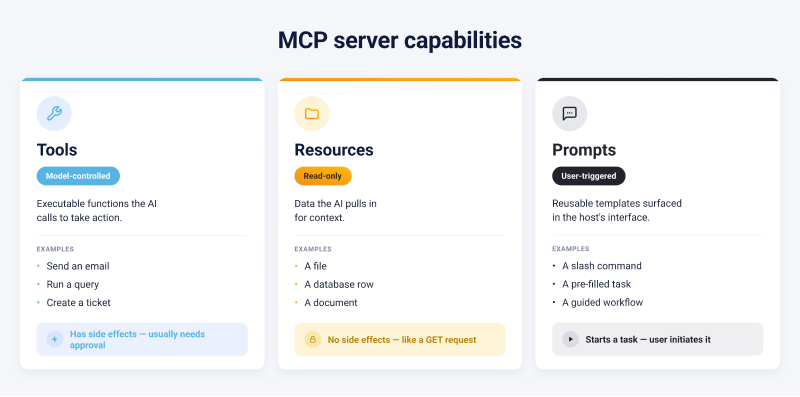
Every MCP server can expose up to three types of capability, each governed by different rules:
- Tools — executable functions the AI can call to take action: send an email, run a query, create a ticket. Tools are model-controlled; the AI decides when to call them based on the conversation.
- Resources — read-only data the AI can pull in for context: a file, a database row, a document. These behave closer to a GET request than a function call, with no side effects.
- Prompts — reusable templates surfaced directly in the host's interface that help a user kick off a well-structured task, similar to a slash command that pre-fills a common request.
Because tools and resources are distinguished at the protocol level, a host can tell the difference between a harmless read and a consequential action without inspecting the contents of every message — which is what makes human-in-the-loop confirmation possible before anything risky happens.
Is MCP the same as a regular API?
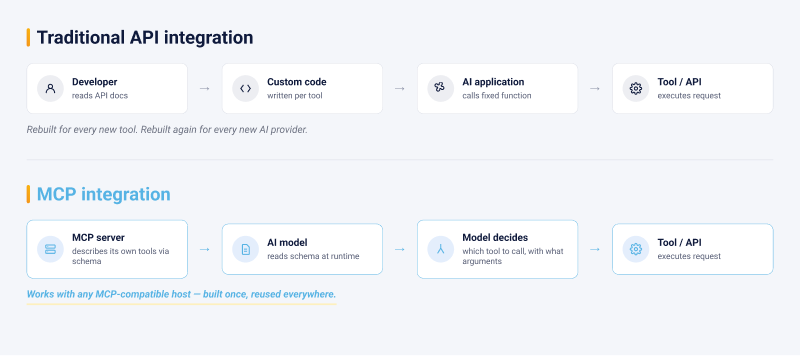
Not quite. MCP servers ultimately call the same REST APIs, databases, and internal systems that any other integration would — the difference is in who does the calling and how discovery works.
A traditional API integration is written once, for one specific use case, by a developer who read the documentation in advance. An MCP server instead describes its own capabilities — names, descriptions, and typed input schemas — in a machine-readable form that the AI model reads and reasons over at runtime. The model decides which tool to call, and with what arguments, based on the conversation, rather than a developer hard-coding that logic ahead of time.
This is also why well-built MCP servers stay narrow in scope. A single server exposing dozens of loosely related tools makes it harder for a model to pick the right one; a small, focused server tends to perform better and is easier for a host to sandbox and secure.
Is MCP secure?
Calling a tool through MCP is, in effect, remote code execution: a tool could delete a file, send an email, or hit a paid API with real consequences. The protocol's design accounts for that. Servers are isolated from one another through separate client connections and never see the full conversation history. The host is expected to show which tools are available, display confirmation prompts before sensitive operations run, and surface exactly what data is about to be sent to a tool before it goes out — a direct defense against a prompt-injection attempt trying to quietly exfiltrate data through a tool call.
That said, MCP is still young infrastructure, and the ecosystem has already had real incidents worth knowing about. In mid-2025, security researchers at Oligo Security disclosed a critical remote-code-execution flaw in MCP Inspector, Anthropic's developer debugging tool, that let an attacker run arbitrary commands on a developer's machine simply by getting them to visit a malicious webpage. The flaw was patched, and Tenable researchers documented the related authentication gap that made it possible. Teams deploying MCP servers in production should treat the protocol the way they'd treat any other infrastructure that executes code and touches sensitive data: pin dependency versions, validate inputs, log invocations, and keep the human-in-the-loop confirmations the protocol was built to support.
How has MCP evolved in 2026?
MCP's trajectory over the past two years has been unusually fast. A few milestones worth knowing:
- Explosive adoption. By mid-2026, the TypeScript and Python SDKs had each individually crossed a billion total downloads, with combined monthly downloads across the protocol's Tier 1 SDKs approaching half a billion.
- Broad industry buy-in. What started as an Anthropic project is now used by ChatGPT, Cursor, Gemini, Microsoft Copilot, and Visual Studio Code, among thousands of other applications — genuinely vendor-neutral in practice, not just on paper.
- A new governance home. In December 2025, Anthropic donated MCP to the Agentic AI Foundation under the Linux Foundation — co-founded alongside Block and OpenAI, with support from Google, Microsoft, AWS, Cloudflare, and Bloomberg — under the same neutral stewardship model used for Kubernetes and Node.js.
- Interactive interfaces. Until early 2026, every MCP interaction was text in, text out. MCP Apps changed that by letting servers deliver interactive HTML interfaces that a host renders inside a sandboxed iframe.
- A stateless core. The 2026-07-28 specification was described by its own maintainers as the largest revision since launch, moving the protocol's core to a stateless architecture that scales on ordinary HTTP infrastructure, alongside a formal extensions framework and hardened, OAuth-aligned authorization.
How does MCP relate to agentic AI?
MCP is infrastructure, not intelligence — it's the plumbing that lets an AI agent actually reach the tools and data it needs to act on a task, rather than just describe what it would do. That is exactly why it sits at the center of the shift from generative AI, which produces content, toward agentic AI, which completes multi-step tasks with a degree of autonomy. Globaldev's guide to agentic AI vs. generative AI vs. predictive AI covers this broader landscape and where MCP-powered solutions fit alongside other agentic frameworks.
MCP is also becoming a factor in enterprise AI vendor evaluation. When Anthropic expanded the Claude Partner Network's Services Track in mid-2026 — a program Globaldev has joined — MCP was named alongside Claude Code and Claude Cowork as one of the core technology surfaces partner firms are expected to build around. Whether a vendor can implement MCP-based integrations is quickly becoming a real evaluation criterion for enterprise buyers, not just a developer curiosity.
What does MCP actually change for engineering teams?
MCP's impact on software development shows up in a few distinct ways, not just one.
Less integration glue code. Before MCP, giving an AI coding assistant access to a codebase's issue tracker, CI/CD pipeline, or internal API meant writing and maintaining a custom connector for each one, then doing it again for every new tool or every new AI provider a team adopted. An MCP server built once — by the tool vendor, an internal platform team, or the open-source community — works with any MCP-compatible host, whether that's an IDE, a terminal-based agent, or a custom internal tool.
Real autonomy without losing control. An AI coding agent connected to an MCP server for GitHub, a ticketing system, and a test runner can pull a ticket's requirements, check out the relevant code, run the existing test suite, and open a pull request — without a developer manually shuttling context between tools. The protocol's tools/resources/prompts split also means a host can let an agent freely read documentation or logs (resources) while still requiring explicit approval before it merges code or deploys anything (tools) — which is what makes it practical to give an agent real autonomy without losing control over what it can actually change.
Reusable infrastructure, not one-off scripts. Platform and DevOps teams increasingly maintain a small set of internal MCP servers — one for deployment tooling, one for observability data, one for internal documentation — that every AI-assisted workflow across the organization can plug into, instead of each project team building its own one-off integration. Standing up and maintaining that kind of internal tooling is real engineering work, which is one reason organizations building it out often lean on dedicated platform or backend engineers rather than folding it into an already-stretched product team; Globaldev's breakdown of software developer roles covers how to think about staffing that kind of work.
Consistency across AI tools. Because the same MCP server works with any compatible host, an organization that switches AI providers — or lets different teams use different ones — doesn't have to rebuild its tool integrations from scratch each time. That portability is a meaningful hedge against vendor lock-in as the AI coding-assistant landscape keeps shifting.
How do I get started with MCP?
Use an existing MCP server when the capability you need already has one — Anthropic maintains a public directory, and most major tools now ship an official or community-built server. Connect it to a host already in use, such as Claude Desktop or an MCP-compatible IDE, and no custom development is required.
Build a custom MCP server when the capability is internal or proprietary — a company's own database, an internal ticketing system, a bespoke API with no existing connector. Building one is a matter of exposing one narrow, well-defined capability, describing it clearly with a typed schema, and letting the protocol handle discovery and invocation from there.
For organizations weighing whether to build MCP integrations in-house or bring in outside engineering support, Globaldev's roundup of top generative AI development companies in 2026 is a useful starting point for comparing how different vendors approach custom AI product development, including agentic and integration work.
Conclusion
MCP isn't the last word in AI-tool integration, and the spec is still evolving quickly. But it has already done the hard part: giving the industry one shared language for how models talk to the outside world, instead of a hundred incompatible ones. As agentic AI adoption accelerates, understanding MCP is becoming as fundamental as understanding APIs was for the previous generation of software integration.
If you're exploring how MCP AI integration, agentic AI, or custom AI development can support your business, Globaldev can help — from AI strategy and architecture through full-scale development and deployment. Ready to build your next AI-powered product or workflow? Let's talk.