The good news is that you don’t need unicorn-level funding to make your idea work. In this guide, we’ll walk you through best practices for developing a dating app and break down what it can cost to bring one to life.
How does Tinder work: The phenomenon of the app
Tinder is a location-based dating app that connects people who express mutual interest. The concept is simple: swipe right to like someone, left to pass. If both users swipe right, a chat window opens and the match begins.
Signing up is straightforward. Users can register with Facebook, Apple, or a phone number. Tinder uses these credentials only for verification and matching—it won’t post on a user’s behalf. Profiles are kept minimal, usually including name, age, interests, profession, religion, political views, and a short bio. Users can also indicate what they’re looking for (e.g., casual dating or a long-term relationship) and link Instagram to showcase more photos.
Matching is primarily based on mutual likes, but the app also factors in location, age range, and profile preferences. Users can adjust filters such as distance or preferred age group to refine their search. Together, these elements create the familiar “swipe” experience that made Tinder a cultural phenomenon.
The main screen contains five large buttons:
- Back arrow to undo the last action
- Large cross (= to “swipe left”) to dismiss a profile
- A lightning bolt to increase user’s visibility in the app
- Heart (= to “swipe right”) to like a profile
- Star to “super like” a user
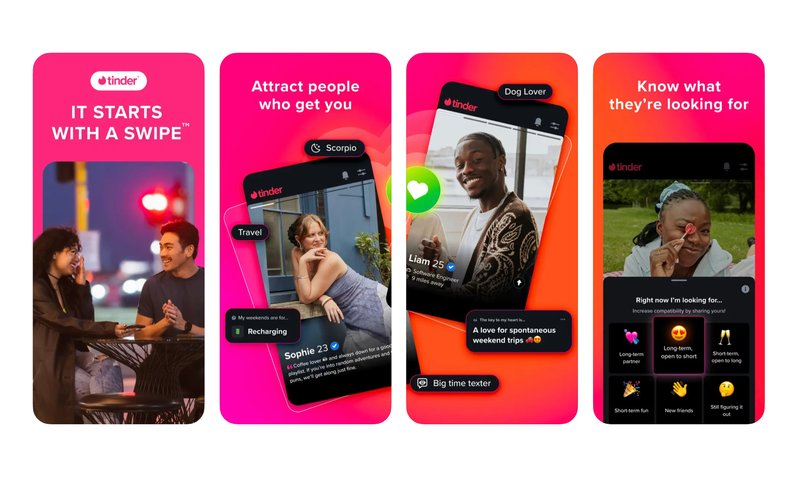
Source: App Store
The main idea of Tinder was explained by one of its creators, Sean Rad:
“No matter who you are, you feel more comfortable approaching somebody if you know they want you to approach them.”
What is the cost of a dating app development?
Before diving into numbers, it’s important to understand what actually drives the cost of an app. From market research and user analysis to UI/UX design and vendor choice, each step adds to the final budget. Careful planning at this stage helps avoid costly mistakes later and ensures your app isn’t just another clone, but a product with real market fit.
Time and cost planning for building a dating app
Worthwhile projects take time. To create an outstanding online dating experience to outrun Tinder, you should be ready for sleepless nights of planning and calculating. Research the main competitors, and get to know their strengths and weaknesses. It should help you understand the industry, what it lacks, and what it expects for a new app to succeed.
Of course, not everything in the online dating market has been invented. There are lots of niches to be taken. Thus, to get to the top, it is necessary to grasp what kind of people will use the app. What is their age? What do they need from the app? The product should be tailored to match the everyday needs of its target audience.
Also, consider how much money you can invest in the app or where to find investors. Making an app with an exquisite design is not a cheap affair.
Finding a technology vendor to build a dating app
Before settling down with a vendor, there are a lot of factors to consider. Do their rates correspond with your budget? How far are they located from your office? Can you deal with language and time zone differences that will strain the communication between you and the outsourcing company?
It’ll be good to investigate the potential vendor, review testimonials, and even talk to their previous clients. Look up their projects in the App Store and Google Play to ensure their work is solid, and they have relevant experience building similar apps.
You can also check reviews on Clutch, where feedback is verified and includes key details like project scope, industry focus, and even hourly development rates. GoodFirms is another reliable platform to compare vendors and get a clearer picture of their expertise and pricing.
Dating app development: wireframing and UI/UX
Building a prototype is one of the significant price-determining factors that decide how much a dating app development is going to cost you. It is necessary to think through every screen, button, and icon. Every small block has to be planned and placed correctly. Every link should direct users to the correct destination, and buttons must be placed logically so actions feel intuitive. All elements have to be consistent to deliver a seamless user experience. Only 10-20% of the design time is spent making a final layout. The other 80% – on thinking about user needs. After all, application design is key to a product’s success.
Developing Tinder-like features
The primary cost driver in building a dating app is technology development: the scope of features, matching logic, and supporting infrastructure. While Tinder began as a location-based matching app, its functionality has expanded significantly, setting a benchmark for what users expect today.
Here’s a breakdown of essential Tinder-like features.
User profile
Developers need to design a flexible profile structure that supports multiple data types: photos, short bios, interests, lifestyle details, and optional integrations with Instagram or Spotify. Adding features like photo loops or prompts introduces extra complexity, as they require dynamic content handling and UI updates.
User settings
From a development standpoint, settings are more than just toggles. They require building robust controls for profile editing, discovery preferences, and privacy management. Features like blocking contacts, hiding age/distance, or turning off discovery involve both frontend UI work and backend logic to enforce user preferences consistently across the app.
Discovery and matching
The core of the app lies in matching algorithms. Developers must implement location-based discovery, filters for age and gender, and behavioral learning that adapts to user swiping patterns. This requires backend infrastructure for geolocation queries and algorithmic fine-tuning to make recommendations relevant at scale.
Chat and interactions
Private chat: Available after a match. Users decide what personal details to share.
Video chat: Allows matching test chemistry before meeting in person.
Moments and prompts: Share photos or personality-driven answers to encourage conversation.
Push notifications
Real-time updates for matches, messages, likes, and special features
Premium features
Monetization features like Tinder Plus, Gold, and Platinum require subscription management, in-app purchases, and access control to unlock advanced capabilities. Developers must integrate with app store billing systems and build logic for premium features such as Passport™ (location spoofing), Boosts, and prioritized likes.
Safety and trust tools
Features like photo verification, AI-powered message moderation, and report/block functionality add significant backend complexity. They require machine learning models or at least rule-based moderation, secure identity verification workflows, and a clear escalation system for flagged content.
How to create a dating app? Start with an MVP
All applications are different, especially when estimating how much time and money the online dating app development requires. You cannot buy custom-built applications at the supermarket with a fixed price tag. Expenses depend on the hired company rates, the app development complexity, and the variety of features you want to stuff into the product.
From a technical perspective, building a simple MVP of a dating app like Tinder can take about 3 to 4 months. The process of creating a minimum viable product for iOS and Android consists of 6 milestones:
- Project planning
- UI/UX design
- iOS app development, Android app development, or Flutter app development
- Back-end development
- Quality assurance
The MVP of a dating app can cost around $35,000, but this is only a ballpark figure — the final price will vary widely depending on the features, technology stack, and complexity you choose to include. So it’s always the best practice to request cost and time estimates.
Conclusion
The biggest lesson from developing a Tinder-like app is this: success doesn’t come from cloning features, but from tailoring them to the people you want to reach. The online dating market still has untapped niches, and the apps that stand out are those built with a clear understanding of their audience. With the right balance of design, technology, and business strategy, your idea can move from concept to market-ready product confidently.
Curious how others did it? Explore our case studies to see how we’ve helped businesses turn bold app ideas into reality, or reach out, and we’ll share more examples from our experience.