How to hire an AI software developer: Skills, cost, and hiring process explained

Bringing on the wrong specialist carries significant financial and operational risks. You must evaluate practical AI experience carefully to ensure your project succeeds. When you look to hire AI software developer talent, prioritize hands-on deployments over theoretical knowledge. Many organizations rely on AI engineers for hire or partner with an AI development company to bridge technical gaps.
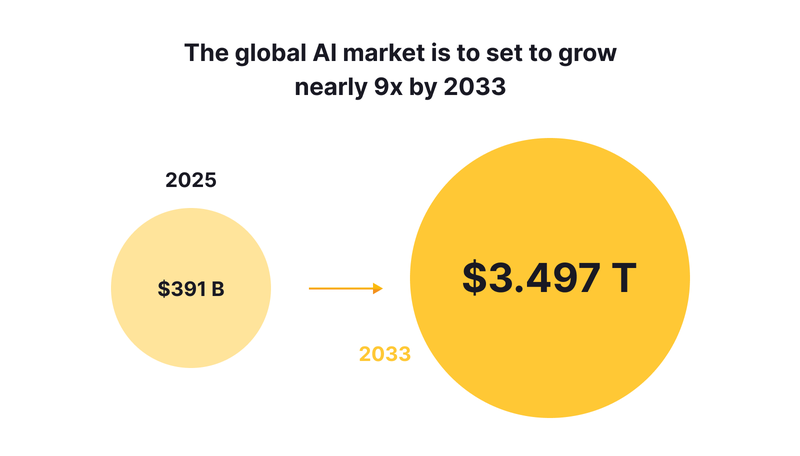
Source: explodingtopics.com
In this guide, we explain how to hire AI developers, what skills to look for, how much AI engineers cost, and when it makes sense to work with an AI development company.
Why hiring AI talent is different from traditional software development
Artificial intelligence projects are fundamentally data-driven. AI development involves constant experimentation and iteration to achieve accurate results. Once deployed, AI systems require continuous model monitoring and scalable infrastructure. This ongoing maintenance makes enterprise AI development and AI product development highly specialized fields.
What does an AI software developer do?
An AI software developer is a specialist who designs, trains, integrates, and deploys machine learning models within software applications. They manage complex backend systems to enable intelligent features.
Typical responsibilities include:
- Training machine learning models on structured and unstructured data.
- Building AI APIs to connect algorithms with user interfaces.
- Integrating models into applications for seamless functionality.
- Managing data pipelines to ensure consistent information flow.
- Monitoring model performance to prevent data drift over time.
Successful AI model integration and AI API development require strict adherence to system architecture guidelines.
What types of AI developers can you hire?
Artificial intelligence projects require different types of technical specialists. You must match the specific role to your business objectives.
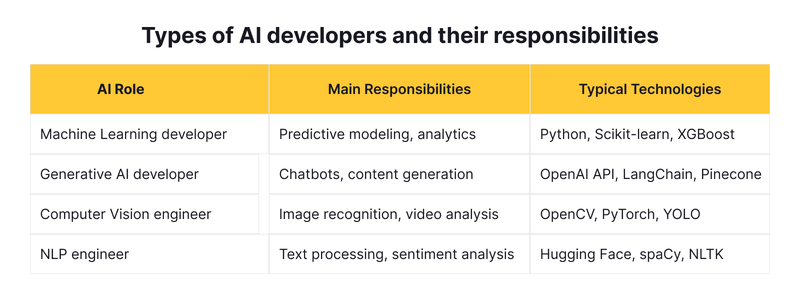
These distinct roles define the precise technical execution of your project.
Machine learning developer
A machine learning developer focuses on extracting patterns from historical information. They build predictive modeling systems to forecast sales or inventory needs. E-commerce platforms frequently use these professionals to build complex recommendation systems. They also specialize in structured data analytics to help businesses process large tabular datasets.
Generative AI / LLM developer
A generative AI developer specializes in large language models and natural language generation. They build intelligent chatbots that handle dynamic customer inquiries. These specialists also develop internal copilots to assist employees with coding or writing tasks. You will need an LLM developer to build RAG (a method that lets an LLM pull answers from a company’s own documents) pipelines that connect enterprise data to AI systems. An AI chatbot developer ensures your automated agents produce accurate and relevant responses.
Computer vision engineer
A computer vision engineer teaches software systems to interpret visual information. They build object detection algorithms for autonomous vehicles or manufacturing lines. Video processing capabilities allow security systems to flag unusual activities automatically. Image recognition models help medical professionals analyze X-rays and MRI scans faster.
NLP engineer
An NLP engineer focuses on teaching machines to understand and process human language. They build sentiment analysis tools to evaluate customer feedback automatically. Language classification models help businesses route support tickets to the correct departments. Advanced text processing algorithms enable efficient document summarization and data extraction.
What skills should an AI developer have?
Understanding what skills an AI developer has ensures a rigorous technical evaluation.
Core technical skills
Every AI professional needs a strong foundation in programming and mathematics. Python is the industry standard language for machine learning algorithms. Developers must possess deep knowledge of frameworks like TensorFlow and PyTorch. They also need robust data engineering basics to extract and transform raw information.
Generative AI and LLM skills
Modern intelligent applications require specific skills related to large language models. Developers must master prompt engineering to control model outputs accurately. They need to understand RAG architecture to augment models with proprietary company data. Seamless API integrations are critical for connecting foundation models to existing software.
Production AI engineering skills
Building a model is only the first phase of the development lifecycle. Developers need strong cloud deployment expertise using AWS, GCP, or Azure. Continuous model monitoring is required to detect accuracy degradation over time. They must design scalable MLOps pipelines to automate training and deployment workflows.
Business understanding
Technical proficiency alone does not guarantee a successful project outcome. AI developers must translate abstract business problems into concrete ML tasks. They need to evaluate ROI to ensure algorithms provide actual financial value. Professionals must design rigorous experiments to test hypotheses before committing resources.
How to hire an AI developer step-by-step
Knowing how to hire AI developer talent requires a structured recruitment process.
Step 1 — Define the AI implementation strategy
Start by clarifying your exact business requirements and project scope. Precise use case definition prevents scope creep and wasted resources. You must document the expected business outcomes to measure project success accurately. A clear AI implementation strategy aligns technical efforts with company objectives.
Step 2 — Identify required AI expertise
Analyze your project scope to determine the exact technical profile required. You must choose between an ML engineer, an LLM developer, or a computer vision engineer. General software engineers cannot handle the mathematical complexity of advanced algorithms. Selecting the correct specialist ensures you build optimal data pipelines and architectures.
Step 3 — Evaluate AI developers
Assessing candidates requires a thorough review of their practical experience. Start by reviewing previous AI projects in their portfolio or GitHub repository. Verifying production deployments confirms they can build scalable, real-world systems. You must prioritize candidates with extensive data pipeline experience. Knowing how to evaluate AI developers protects your organization from costly hiring mistakes.
Step 4 — Conduct technical interviews
Technical interviews must test practical problem-solving over theoretical knowledge. Ask detailed architecture questions to understand how they structure complex systems. Scenario-based evaluation reveals how candidates handle noisy data or model drift. Require candidates to walk you through an MLOps deployment pipeline step by step.
In-house vs freelance vs AI development company
You must select a hiring model that aligns with your budget and project complexity. Each approach offers distinct advantages for specific business scenarios.
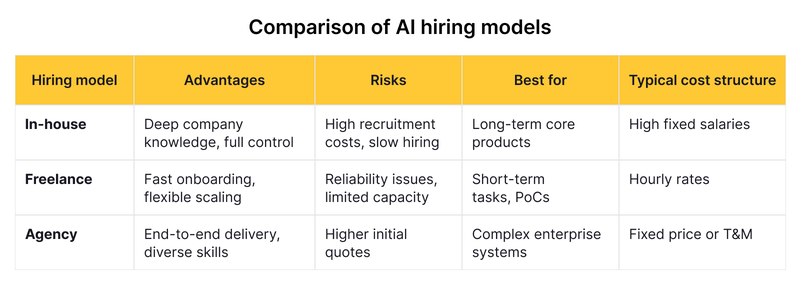
Many businesses use AI development outsourcing to mitigate technical risks. Partnering with an AI development company provides access to specialized infrastructure. Alternatively, engaging AI engineers for hire offers temporary staff augmentation.
Dedicated AI developers vs full AI teams
You must decide between hiring a dedicated AI developer and building a complete AI development team structure.
A dedicated AI developer operates as an individual contributor on specific algorithm tasks. Building a complete AI team provides comprehensive system coverage.
Typical AI team composition includes:
- ML engineer for algorithm creation.
- Data engineer for pipeline management.
- Backend engineer for API development.
- AI architect for system design.
How do you know if you need an AI developer or a full AI team?
The decision depends on the scope of your AI project.
A single AI developer is usually sufficient for focused tasks such as building a machine learning model, integrating an API, or developing a proof of concept. However, production-level AI systems typically require a full team that includes ML engineers, data engineers, backend developers, and AI architects.
According to McKinsey, organizations that deploy AI successfully often rely on cross-functional teams, as AI solutions require coordinated work across data infrastructure, model development, and system integration.
Smaller projects can be delivered by individual specialists, but scalable AI platforms usually need multiple roles to ensure reliability, security, and long-term maintainability.
How much does it cost to hire an AI developer?
The cost to hire AI developer professionals depends heavily on location and expertise.
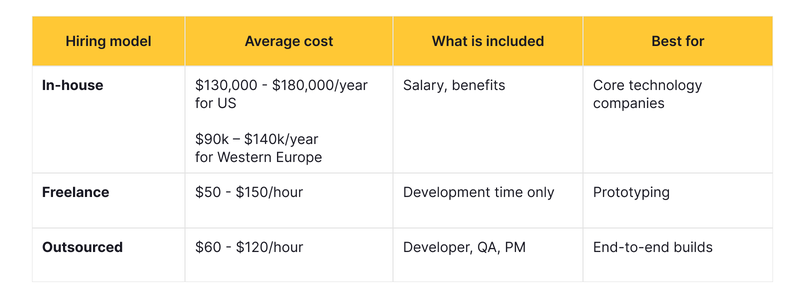
Businesses must also account for significant hidden costs during development. Cloud infrastructure and GPU computing resources require substantial monthly budgets. Maintaining data pipelines and storage adds continuous operational expenses. Lengthy experimentation cycles frequently extend project timelines and increase overall costs.
Common mistakes when hiring AI developers
Avoiding recruitment pitfalls saves time and protects your budget.
Many companies fail by hiring general developers instead of specialized AI engineers. Ignoring data preparation complexity leads to models that perform poorly in production. Skipping model monitoring causes accuracy to degrade silently over time. Building AI before validating the problem results in solutions nobody actually needs.
When to work with an AI development company
Certain scenarios require the robust infrastructure of an external vendor.
A critical lack of internal AI expertise often stalls enterprise initiatives. A need for faster MVP development justifies partnering with external specialists. Complex AI architecture requirements demand multiple engineering disciplines working together. In these situations, custom AI development services provide guaranteed delivery frameworks. An experienced AI consulting company can map your business needs to technical reality.
Globaldev expertise in how to hire an AI software developer
At Globaldev, we approach this as both a sourcing and recruitment problem. To hire AI developer talent successfully, we do not rely on generic hiring workflows. Instead, we combine market mapping, role calibration, technical pre-screening, and structured evaluation to identify specialists who can contribute to real business outcomes.
This is especially important for companies looking to hire artificial intelligence developer talent for complex use cases such as LLM-based products, AI integrations, automation platforms, recommendation engines, intelligent assistants, and enterprise-grade AI systems.
How Globaldev approaches AI hiring
Our hiring process is built around two core principles:
- understanding exactly what kind of AI expertise the client needs
- building a search and evaluation process around that specific context
This matters because one client may need a generative AI developer who can work with LLM orchestration and RAG pipelines. And another may look for a machine learning developer who can build predictive models. That is why our recruitment team’s work starts long before candidate outreach.
AI talent sourcing: How Globaldev builds the search strategy
When companies ask how to hire AI developer talent efficiently, the answer begins with sourcing. Strong sourcing is what defines the quality of the pipeline. In AI hiring, this stage is especially important because niche specialists are rarely visible through a single channel.
At Globaldev, sourcing AI talent is a research-driven process rather than a simple keyword search.
Market mapping of the AI talent landscape
Our sourcing process starts with a detailed review of the AI market. We analyze where AI specialists typically work, including:
- AI startups
- R&D labs
- product companies building AI-first solutions
- innovation teams inside larger enterprises
- professional AI communities
- open-source ecosystems
The purpose of this stage is to identify where the strongest talent is concentrated and where the most relevant candidates are likely to come from.
We also study competitor clusters and adjacent employers to understand where professionals with similar experience may currently be working. This gives us a more realistic view of the hiring landscape and helps shape the sourcing strategy from the start.
Compensation analysis and market realities
An effective hiring strategy must also be aligned with market conditions. Compensation for AI specialists depends on several factors:
- complexity of the technology stack
- scarcity of the expertise
- candidate location
- seniority
- direct impact on business outcomes
In practice, specialists working in LLMs, GenAI, deep learning research, and enterprise MLOps often have higher compensation expectations than engineers in more common software roles. This is a critical part of the discussion for companies estimating the cost to hire AI developer talent.
Regional focus: Eastern, Central, and Western Europe
In many hiring projects, clients initially look at Western Europe but then shift attention toward Eastern and Central Europe. The reason is straightforward: these regions offer strong engineering quality, good English proficiency, and access to specialists with relevant AI and backend expertise.
At Globaldev, we often see strong candidate pools in countries such as Poland and Ukraine, especially for roles related to LLM implementation, AI-enabled backend development, applied machine learning, and scalable engineering.
Role definition before sourcing: Why context matters
One of the biggest reasons AI hiring fails is vague role definition. Before starting the search, we work to clarify what kind of specialist the client actually needs. This is essential because titles in AI are often inconsistent. A candidate who could be ideal for one project may use a completely different title from what the client originally requested.
That is why our team defines:
- the actual business goal behind the role
- the specific AI use case
- required technical depth
- production vs experimental experience
- leadership expectations
- architecture ownership
- must-have and nice-to-have competencies
This approach helps expand the search funnel without sacrificing relevance.
Matching the role to the business objective
The right AI hire depends on the business model and product stage. A company building an internal AI assistant may need an engineer experienced in AI chatbot developer tasks, prompt workflows, RAG pipelines, and API integrations. A business that develops a new SaaS product may need a senior engineer focused on AI product development and AI MVP development. An enterprise client may require experience in enterprise AI development, governance, cloud infrastructure, and production reliability.
This is why Globaldev treats hiring as part of a broader AI implementation strategy, not just a staffing request.
Building the candidate profile for AI roles
Once the business context is clear, we create a detailed candidate profile. This includes the target title, alternative title variations, required frameworks, cloud exposure, architectural scope, and expected production experience.
This distinction matters because many companies confuse adjacent roles. In practice, there is a major difference between an AI application engineer, a research-oriented ML specialist, and a backend engineer with GenAI exposure.
That is why content answering AI developer vs ML engineer is valuable both for buyers and for search visibility. These roles overlap, but they are not interchangeable.
Recruitment process: How Globaldev evaluates AI candidates
Sourcing creates the pipeline, but recruitment determines whether the right people move forward. After identifying relevant candidates, Globaldev follows a structured recruitment process designed for technical roles with AI complexity.
Step 1. HR interview and role alignment
The first step is an HR interview that validates core fit factors:
- communication level
- project motivation
- ability to work in the required format
- relevant career trajectory
- alignment with the opportunity
For AI roles, this stage is also important because it helps distinguish between candidates who have explored AI casually and those who have worked with it in real delivery environments.
Step 2. Early technical pre-screening
One of the biggest challenges when companies hire AI developer talent is evaluating technical depth early enough in the process. Recruiters alone cannot fully validate advanced AI expertise, especially for roles involving LLMs, machine learning pipelines, or complex AI integrations.
To address this, Globaldev adds an early technical pre-screening stage for many roles.
For this purpose, we use Gen-AI, Globaldev’s AI-powered recruiting tool designed to significantly reduce screening time while improving technical evaluation. Gen-AI allows candidates to complete a structured technical session based on pre-set questions that are reviewed and approved by the client before the hiring process begins.
This ensures that the screening is aligned with the real technical requirements of the role rather than relying on generic interview questions.
The session typically takes around 20–30 minutes and helps evaluate whether the candidate has practical experience in areas such as:
- LLM integration
- production use of GenAI tools
- backend architecture for AI systems
- model deployment concepts
- real engineering decision-making
After completing the session, the system generates a summary that helps both recruiters and clients better understand the candidate’s technical capabilities before the next interview stage.
Step 3. Technical interview with engineering experts
After the initial evaluation, candidates move to a deeper technical discussion with engineering experts. The structure of this stage depends on the hiring model.
- For AI development outsourcing roles, the technical interview is usually conducted by a technical lead from the Globaldev engineering team.
- For the outstaffing model, the technical interview is typically conducted by a technical expert or engineering lead from the client’s team. In this case, the client evaluates how well the candidate fits their existing architecture, product roadmap, and engineering culture.
Depending on the complexity of the role, the process may include one or several technical discussions.
Step 4. Optional assessment or assignment
Some processes include a test task or practical exercise. However, many clients are moving away from long assignments, especially for senior talent. In AI hiring, long test projects can reduce candidate engagement and slow down the process.
Step 5. Final interview and team fit
The last stage usually focuses on communication style, collaboration approach, and business alignment. At this point, the goal is no longer to verify raw technical skill, but to confirm whether the candidate fits the client team, decision-making structure, and delivery model.
This is especially relevant when the candidate is expected to work as a dedicated AI developer, lead a stream, or become part of a broader AI development team structure.
Recruitment flexibility depending on the role
Not every AI role should be hired through the same process. A senior architect-level role requires a different evaluation path than an early-career engineering position.
Senior and leadership AI roles
For senior hires, we place stronger emphasis on:
- architecture ownership
- leadership background
- production scale
- decision-making maturity
- ability to align technical choices with business strategy
This is particularly important when the goal is not just to hire AI developer talent, but to build leadership capacity for future growth.
Growth roles and internal AI capability building
In addition to hiring senior specialists, Globaldev also supports long-term capability building. For some internal and scalable talent initiatives, we look for strong software engineering fundamentals and then help develop AI specialization further through structured learning and mentorship.
This approach is useful when the market has a limited number of immediately available specialists, but there is an opportunity to grow them into AI delivery roles over time.
Why companies choose Globaldev for AI hiring
Globaldev’s approach combines structured sourcing, technical filtering, and hiring flexibility. Instead of treating AI recruitment as a standard engineering search, we build the process around role complexity, business context, and delivery reality.
This is valuable for companies that need:
- fast access to specialized talent
- support in defining AI roles correctly
- help comparing freelance vs in-house AI developer options
- guidance on AI development team structure
- support with AI development outsourcing
- expertise in building scalable AI teams
For some clients, the right option is a single senior specialist. For others, it is a broader team that may include backend engineers, AI engineers, ML specialists, product stakeholders, and delivery support. In these cases, the hiring conversation becomes part of a larger decision around AI integration services, enterprise AI development, and long-term product strategy.
Conclusion
Hiring the right AI developer requires a structured approach. Companies must clearly define their AI goals, identify the type of specialist they need, and carefully evaluate real-world experience with data pipelines, model deployment, and scalable infrastructure. Choosing the right hiring model, whether in-house, freelance, or through an AI development company, can significantly influence project success and overall costs.
If you need experienced AI engineers for hire or support building a dedicated AI team, working with a trusted partner can simplify the process. Globaldev helps companies hire AI developers, assemble specialized teams, and deliver reliable custom AI development services for complex projects.