Is outsourcing to Vietnam right for your business?

Vietnam's IT services market is estimated at USD 2.63 billion in 2026 and is projected to reach USD 4.39 billion by 2031. That growth is not driven by cheap rates alone. It reflects a maturing software development ecosystem, a young and rapidly expanding engineering workforce, and government policies that are actively attracting foreign tech investment.
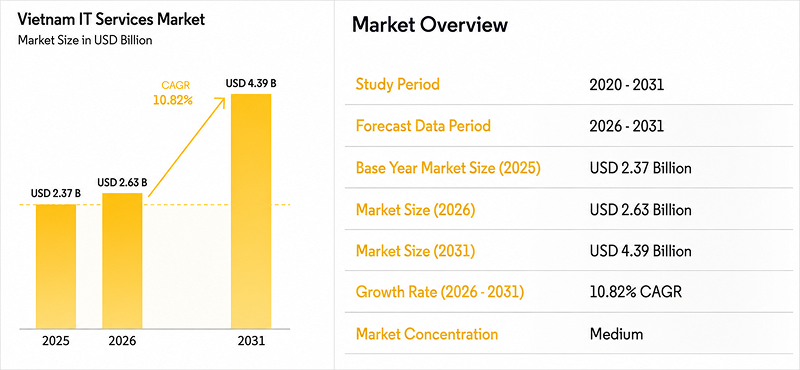
Source: Mordor Intelligence
This article is for CTOs, founders, and product leads who are evaluating offshore options and want a clear, honest picture of what outsourcing to Vietnam actually looks like in 2026 — the opportunities, the trade-offs, and how to decide whether it fits your specific situation.
Why Vietnam has emerged as a top outsourcing destination
A decade ago, Vietnam competed primarily on cost. Today, the conversation has shifted. Vietnamese software development companies are delivering across custom software development, AI and ML, cloud infrastructure, and mobile products, not just executing low-complexity tasks.
Several forces are converging to accelerate Vietnam's rise as a tech outsourcing destination:
- Government backing with real teeth: In May 2025, Vietnam introduced a 3-year Corporate Income Tax exemption for newly established SMEs, including foreign-owned IT firms. This significantly reduces the barrier for international companies setting up delivery centers or engaging local vendors.
- A maturing outsourcing ecosystem: Vietnam now ranks among the top IT outsourcing destinations globally, second only to India in terms of offshore software delivery capacity in Asia. The country has built that position over two decades of sustained investment in tech education and infrastructure.
- AI and cloud capabilities entering the mainstream: Vietnam's outsourcing companies are incorporating AI-powered tools to optimize delivery workflows and improve the quality of outsourced services. The underlying talent pipeline is genuinely strong in mathematics, algorithms, and applied ML.
- A regional operating advantage: For companies in Singapore, Australia, Japan, and South Korea, Vietnam is effectively nearshore. The time zone (GMT+7) allows same-day collaboration with most of Asia-Pacific and meaningful overlap with European working hours.
The Vietnam tech talent pool: What you're actually getting
When you hire developers in Vietnam, you are accessing one of the most rapidly scaling software engineering workforces in the world.
Vietnam's 2025 ICT landscape shows a software workforce of over 560,000 engineers, with 55,000 to 60,000 new software graduates entering the market each year. Vietnam ranks among the top 10 countries globally for developer capabilities, and 2nd in the Best Freelancer Survey.
As Phillip Bui, VP of Asia Business Operations at Globaldev Group explained: "We are in a golden period. The working population is quite young and still being well educated in technology. Vietnam is quite good in mathematics — logical thinking. A lot of companies and universities here are well known for this."
That mathematical foundation translates directly into engineering strength. Vietnamese software engineers consistently perform well in:
- Algorithms and data structures — a strength rooted in Vietnam's mathematics education system
- Full-stack and mobile development — the most common engagement type for international clients
- AI and machine learning — a rapidly growing cohort of ML-native engineers
- Cloud and DevOps — strong availability of AWS, Azure, and GCP-certified professionals
The country is producing an AI-native generation, engineers who are adapting to generative AI workflows faster than many more established markets.
What you get when you build an offshore development team in Vietnam is not just affordable capacity. You get engineers who are hands-on, delivery-focused, and committed to long-term project ownership.
In the words of Phillip Bui: "It's not a short game — jump in, take the money, and leave. It's more like a long-term dedication to supporting the project."
Cost comparison: Vietnam vs other outsourcing destinations
Vietnam IT outsourcing costs run 60 to 70% below Western market rates, but that headline number needs context.
The table below gives a practical orientation across the main outsourcing geographies.
Vietnam developer hourly rates are competitive even within Asia. Singapore costs 30 to 40% more despite being geographically adjacent. India overlaps in rate range but presents a different set of trade-offs around communication style, attrition, and delivery culture.
Lower rates in Vietnam do not reflect lower technical quality. They reflect Vietnam's economic context: a lower cost of living, a younger workforce that has not yet experienced the salary inflation that more mature markets have, and a government-backed education system that keeps engineering talent accessible.
What to expect in 2027 and beyond
Salary inflation in Vietnam's tech sector is real. Senior AI and cloud specialists are commanding increasing premiums as demand from Japanese, Australian, and Singaporean clients intensifies. Companies building long-term offshore teams in Vietnam should factor in annual salary growth of 8 to 12% for senior roles. The arbitrage will narrow, but the talent quality argument will grow stronger.
What services can you outsource to Vietnam?
Vietnamese software development companies cover the full spectrum of modern technology delivery:
- Custom software development remains the core. Whether you need a greenfield product, a platform rebuild, or ongoing feature development, Vietnam's engineering teams are equipped to deliver.
- AI and generative AI development is growing rapidly. The Vietnam tech talent pool in 2026 includes a meaningful cohort of ML engineers, data scientists, and AI practitioners working on production-grade systems. Vietnam generative AI outsourcing is a real capability, not just a marketing claim.
- Cloud migration and DevOps are well-established, with strong availability of certified engineers across Ho Chi Minh City and Hanoi.
- Mobile and web application development, QA and testing, and back-office BPO operations are mature service categories with an established track record.
- Digital transformation consulting has become a standard offering from serious Vietnamese vendors.
"A lot of questions come from the client, and the client expects us to answer all the questions they have. That's why we added digital transformation consulting — we come in, assess the system, brainstorm the tech roadmap, and then highlight where to start." Phillip Bui, VP of Asia Business Operations at Globaldev Group
This end-to-end posture increasingly distinguishes mature Vietnam software development companies from simple staffing shops.
Globaldev's Vietnam hub covers custom software development, AI and ML engineering, cloud and DevOps, and staff augmentation — operating alongside our Eastern European teams to give clients dual-geography flexibility.
Key advantages of outsourcing to Vietnam
- Cost efficiency without quality compromise. The 60 to 70% cost differential versus Western markets is real and sustained. For startups, this directly expands what is buildable within a given budget — outsourcing benefits for startups in Vietnam are primarily economic without sacrificing delivery quality.
- A young, growing talent pipeline. With 55,000+ new graduates annually and a culture that prizes engineering, Vietnam's talent supply is expanding rather than tightening — the opposite of what many Western and Eastern European markets are experiencing.
- Time zone workability for remote work. Vietnam's GMT+7 time zone gives meaningful overlap with Europe (early Vietnam morning aligns with late CET afternoon) and same-day turnaround with Australia and Japan. For US West Coast teams, evening PST standups connect with morning Ho Chi Minh City starts. Vietnam time zone for remote work is genuinely manageable for structured collaboration.
- Delivery culture and work ethic. Vietnamese engineers are characteristically hands-on and result-oriented. The cultural norm is to show the work rather than explain the delay, a trait that clients from Europe and Australia consistently flag as a differentiator versus other offshore markets.
- Macroeconomic stability and government incentives. Vietnam's GDP growth is projected at 6.5% for 2026, among the highest in Southeast Asia. Tax incentives for foreign-invested tech firms, relaxed foreign investment rules, and continued infrastructure development make the operating environment increasingly favorable for Vietnam digital transformation 2026 and beyond.
- A proven track record with global enterprises. National Australia Bank has built a delivery center of over 1,000 engineers in Vietnam. Japanese companies have relocated thousands of Vietnamese engineers to work in Tokyo. This is not an emerging market story, it is a proven one. Nearshore outsourcing in the Asia-Pacific region consistently flows through Vietnam.
Challenges and risks of outsourcing to Vietnam
Honest evaluation of outsourcing to Vietnam means accounting for the real constraints, not just the advantages:
English proficiency
Vietnam ranks 8th in Asia and 63rd globally in the 2024 Global English Proficiency Index. Demand for English-speaking talent is improving this quickly, particularly among engineers working with international clients. But it remains a genuine consideration for communication-intensive roles.
As Phillip Bui, VP of Asia Business Operations at Globaldev Group acknowledged: "Indian engineers speak well. They can talk natively. But sometimes they talk over delivery. Vietnamese engineers are more hands-on. We don't speak much, but we want to show the result."
That dynamic is worth understanding rather than dismissing.
Mitigation: Choose vendors with demonstrated international client experience. Prioritize engineers who have worked in English-language environments for multiple years.
Data protection and Vietnam GDPR compliance
Vietnam's Decree 13 moves data regulation toward GDPR-adjacent standards, but Vietnam GDPR data compliance is not fully equivalent. For EU-based companies handling personal data, this creates a gap that needs to be addressed contractually and architecturally. Data residency requirements, DPA agreements, and data minimization practices are important safeguards.
Mitigation: Structure data access so offshore teams handle pseudonymized or non-personal data where possible. Build contractual data processing agreements with teams.
Time zone friction
The GMT+7 time zone works well for async-first teams and structured sprint reviews, but creates friction for organizations that rely on continuous real-time collaboration with European stakeholders.
Mitigation: Define a daily sync window, not continuous availability. Or pair a Vietnam team with a nearshore point of contact in Eastern Europe.
Talent retention
Vietnam's tech market is competitive. Senior engineers with AI or cloud specializations are increasingly sought after. Retention risk concentrates at the senior end.
Mitigation: Engagement models that give engineers ownership, growth opportunities, and technically interesting work retain talent more effectively than rate premiums alone.
Vietnam vs Eastern Europe: Which is right for you?
Globaldev operates hubs in both regions, which gives us a practical rather than theoretical view of this comparison. The full Vietnam vs Eastern Europe software development breakdown deserves its own article, but here is the essential framework.
When Vietnam wins:
- You are based in APAC, Australia, or Japan and want genuine time zone alignment
- Budget is a primary constraint and you need to maximize engineering capacity
- Your project is well-specified and delivery-focused
- You want access to Vietnam generative AI outsourcing or ML engineering
When Eastern Europe wins:
- You are an EU company with strict GDPR requirements
- Your project requires intensive real-time collaboration with European stakeholders
- English fluency is critical for the nature of the engagement
- You need deep domain alignment with Western European industries
The case for a dual-geography strategy. Many Globaldev clients combine both regions: Eastern European engineers for architecture, client-facing communication, and compliance-sensitive components; Vietnam teams for delivery capacity and AI engineering throughput. This hybrid model captures the strengths of both and reduces concentration risk.
How to find the right Vietnam outsourcing partner
Finding the right offshore development team in Vietnam is not about finding a vendor with the most certifications. It is about technical depth, delivery culture, and operational maturity.
What to look for when evaluating how to find an outsourcing partner in Vietnam:
- Senior engineers who can engage on architecture and product decisions, not just execute tickets
- A delivery track record with clients in your industry or at your growth stage
- Structured communication practices: sprint cadence, documentation standards, escalation paths
- Low attrition and engineers who have been with the firm for multiple years
Red flags:
- Vendors who quote aggressively without asking technical questions
- Senior-to-junior ratios that look good in proposals but flip after signing
- No evidence of long-term client relationships
- Vague answers on data security and IP assignment
Engagement models for outsourcing to Vietnam:
- Dedicated team Vietnam: A vetted group works exclusively on your product under your direction. Best balance of control and flexibility for first-time Vietnam engagements.
- Staff augmentation Vietnam: Extend your existing team with specific capabilities quickly.
- Project-based: Defined scope, defined output. Requires careful specification to avoid underdelivery.
Questions to ask during vendor evaluation:
- Can you connect me with two or three client references directly?
- What is the average tenure of your senior engineers?
- How do you handle knowledge transfer when a key engineer leaves?
- Walk me through a project that went off track and how you handled it.
- How do you structure offshore team communication across time zones?
Globaldev's Vietnam hub operates with senior engineers who have deep client-facing experience, structured delivery practices aligned with our Eastern European standards, and clear IP and data handling agreements built into every engagement.
Is outsourcing to Vietnam right for your business?
Vietnam is likely a strong fit if:
- You are a startup or scale-up maximizing engineering output within a defined budget
- You are building a product requiring full-stack, mobile, or AI/ML capabilities
- You can work effectively in an async-first collaboration model
- Your data compliance requirements are manageable within Vietnam's current regulatory framework
- You are based in APAC or want geographic proximity to your delivery team
- You are looking for the best outsourcing country for small business that needs to move fast
Consider alternatives or a hybrid model if:
- Your engagement requires continuous real-time EU collaboration
- You handle EU personal data at scale and need full GDPR equivalence
- Your project is highly ambiguous and requires intensive verbal communication
- You need deep domain knowledge in a highly regulated EU industry
The bottom line: Vietnam is a serious option, not a fallback. Its fit depends on your project type, compliance context, and collaboration style. Companies that succeed with Vietnam outsourcing typically combine clear specifications, a structured onboarding process, and a vendor they have genuinely vetted, and they measure outsourcing ROI for tech companies not just in cost savings but in delivery speed and engineering output.
Conclusion
Vietnam has moved well past the cheap alternative positioning. It is now a capable, growing, and strategically interesting destination for software outsourcing, increasingly chosen by companies in Japan, Australia, Singapore, and Europe not just for cost, but for engineering quality, AI capability, and delivery culture.
Whether it is right for your business depends on the specifics. Globaldev has an on-the-ground presence in Vietnam and can help you evaluate the fit, whether that means building a dedicated team in Vietnam, structuring a hybrid engagement across Vietnam and Eastern Europe, or honestly telling you that a different model serves your context better.
Contact us to discuss your project, or book a consultation to explore what a Vietnam delivery model would look like for your team.