AI trends 2026: What will build your business and what could break it

That distinction matters more this year than ever. The AI landscape in 2026 has split into two camps: the teams extracting compounding value from AI, and the teams quietly absorbing compounding costs from AI they don’t fully control. And if you’re a CTO, product leader, or founder, knowing which trends belong in which camp — and which ones are about to affect your stack — is the difference between a competitive advantage and a very expensive lesson.
This article breaks down the biggest artificial intelligence trends for 2026: six that represent real opportunities, and six that represent genuine risks.
Where are we in 2026?
Before diving into individual trends, it’s worth framing the current state honestly.
Analysts from the RAND Corporation put the AI project failure rate above 80%. Gartner predicted that at least 30–50% of generative AI projects would be abandoned after PoC by the end of 2025. The numbers are consistent with what engineering teams on the ground report: pilots are easy to start, but production-grade AI is hard to sustain. We explored the underlying reasons in detail in Beyond the hype: Why AI projects fail.
What has changed in 2026 is the stakes. The tooling has matured, the regulation has hardened, and the competitive pressure has intensified. If you haven’t moved past the pilot stage, you are now genuinely behind, but the companies that rushed in carelessly are now paying for it.
Here’s what the landscape actually looks like right now.
Where are the real opportunities?
1. Agentic AI goes mainstream
The shift from AI that answers questions to AI that takes actions is the single biggest structural change in the industry this year.
Agentic AI is autonomous AI systems that plan, execute multi-step tasks, and interact with external tools. It has moved well beyond research demos. Tools like Devin (Cognition), Amazon Bedrock Agents, and custom-built multi-agent architectures are now running real workflows: triaging support queues, generating and reviewing code, orchestrating data pipelines, managing procurement approvals.
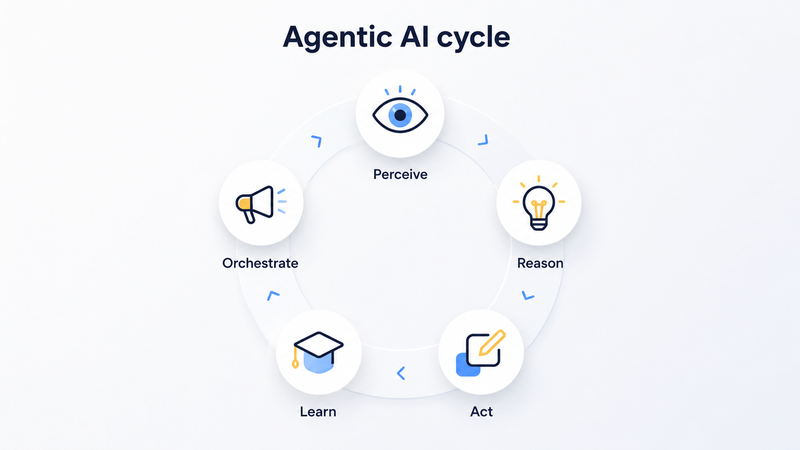
The infrastructure supporting this has matured rapidly. Model Context Protocol (MCP), an open standard for connecting AI agents to external data and tools, has become the de facto integration layer. Vector databases and retrieval-augmented generation (RAG) setups are now standard components of any production AI stack, giving agents reliable access to proprietary company data without retraining.
For a breakdown of AI agent use cases by business type, see our AI development services overview.
2. Smaller, smarter models (SLMs) change the cost equation
For two years, the AI race was a size race: bigger models, bigger compute bills, bigger promises. That logic is now being challenged by small language models (SLMs).
Models in the 1–13 billion parameter range (Meta’s Llama variants, Mistral’s open-source releases, and a growing number of domain-specific alternatives) are now matching or outperforming much larger models on specific tasks. Fine-tuned on proprietary data, they can run on-premise or at the edge, with dramatically lower latency and inference costs.
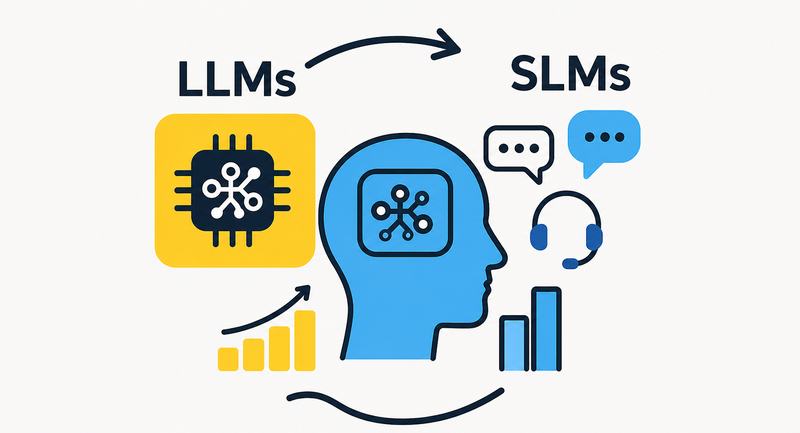
For enterprise teams, this is significant. Edge inference, running models directly on devices or local servers, removes cloud dependency, reduces data exposure, and makes real-time AI viable in latency-sensitive applications like industrial automation, healthcare diagnostics, and secure financial processing.
3. Multimodal AI unlocks new products
Language models that only process text are increasingly the exception. The leading frontier models from OpenAI (GPT-4o), Google DeepMind (Gemini), and Anthropic (Claude) now handle text, images, audio, video, and structured data within a single inference call.
This is not just a capability upgrade. It opens entirely new product categories. Document intelligence (extracting structured data from invoices, contracts, and medical records), visual quality control in manufacturing, voice-native interfaces for field teams, and real-time video analysis are all now buildable with standard API access.
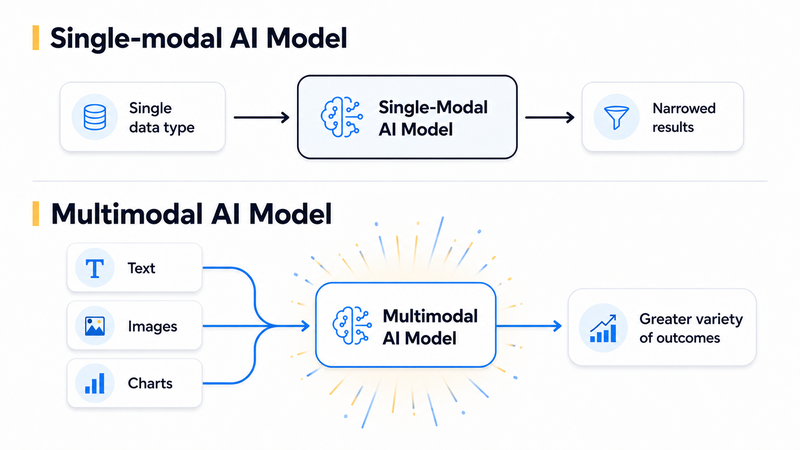
The most immediate enterprise applications are in documents and data extraction, areas where human-labeled data is expensive and the volume of unstructured inputs is high.
4. AI-augmented software development
AI’s impact on software development has moved well past autocomplete. In 2026, the serious question isn’t whether to use AI coding tools, it’s how deeply to integrate them into your engineering workflow.
Tools like GitHub Copilot are now handling code generation, test writing, documentation, code review, and bug triage. More advanced setups use agentic AI for entire feature branches: the developer defines the goal, the agent generates implementation options, and humans review and merge. In production teams, the workflow is disciplined: AI functions as a force multiplier with engineers maintaining decision authority, not a hands-off automation layer.
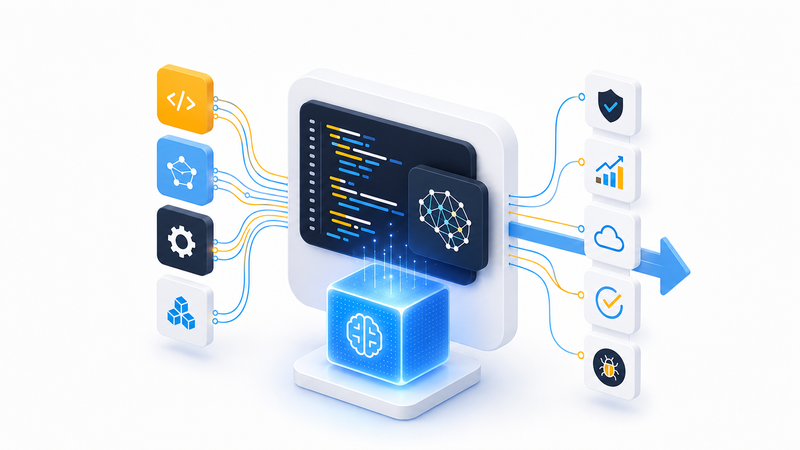
The impact on team output is measurable. Studies consistently show AI-augmented developers completing tasks 40–50% faster on tasks well-suited to the tooling. For teams using staff augmentation models, AI tooling is now a baseline expectation, not a differentiator.
5. Vertical AI beats general models
General-purpose AI is useful. Domain-specific AI is transformative.
Vertical AI is models trained or fine-tuned for a specific industry, use case, or data type. It is now consistently outperforming general models in production environments. In healthcare, specialized models are achieving diagnostic accuracy that rivals specialists in narrow imaging tasks. In fintech, fine-tuned models for fraud detection, credit underwriting, and regulatory document processing are delivering reliability that general models can’t match. In legal tech, AI models trained on jurisdiction-specific case law and contract structures are compressing review timelines dramatically.
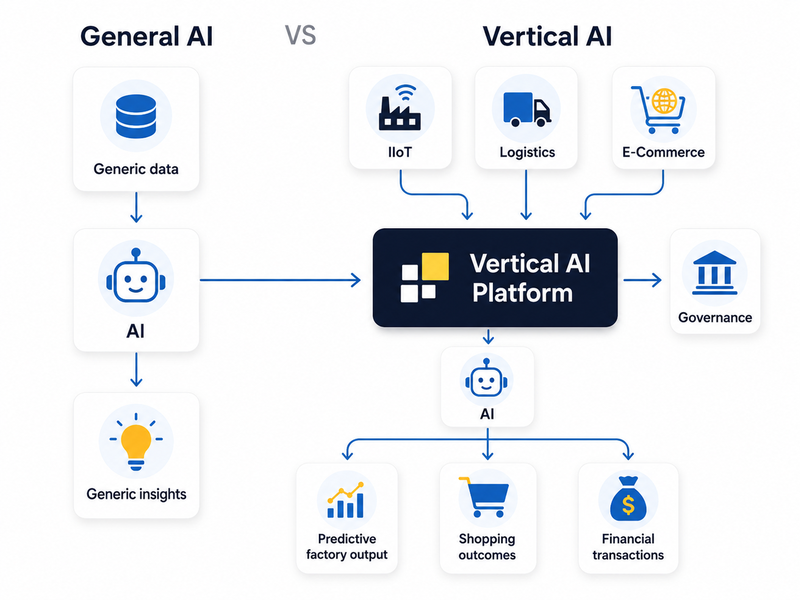
The top machine learning applications across industries in 2026 share a common pattern: the value is in the domain specificity, not the model size.
We covered this specifically for healthcare in Artificial intelligence for healthcare: 5 trends to watch.
6. Open-source AI closes the gap
For most of AI’s recent history, the frontier was proprietary: the best models were locked behind commercial APIs, and open-source alternatives lagged meaningfully behind. That gap has narrowed considerably.
Meta’s Llama models, Mistral’s European open-source releases, and the growing Hugging Face ecosystem now offer capabilities that were state-of-the-art proprietary just eighteen months ago. For many standard enterprise tasks (document processing, classification, summarization, code generation) open-source models are genuinely competitive.
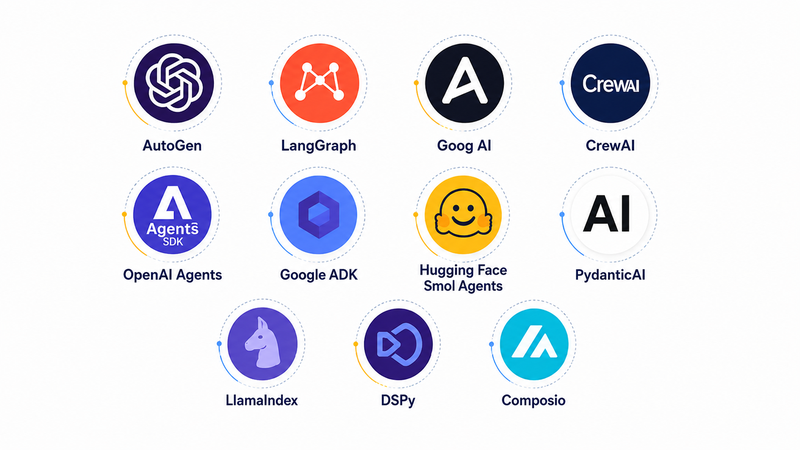
The business implications are significant. Self-hosted open-source LLMs eliminate per-token API costs, give teams full control over data sovereignty, reduce vendor lock-in risk, and enable fine-tuning on proprietary datasets that organizations wouldn’t expose to third-party APIs.
For teams already evaluating Eastern Europe as an AI development hub, open-source competency is increasingly part of what to look for in a technical partner.
Where are the real risks?
1. Regulation tightens, and enforcement begins
For two years, the EU AI Act was a compliance deadline on the horizon. In 2026, it is an active enforcement framework. High-risk AI applications in hiring, credit scoring, healthcare, and critical infrastructure are now subject to mandatory conformity assessments, transparency obligations, and human oversight requirements. Non-compliance carries fines of up to €30 million or 6% of global annual turnover.
For companies operating across jurisdictions, the regulatory complexity compounds: US federal AI guidance, state-level legislation, sector-specific rules from financial regulators, and evolving data protection frameworks all interact with varying levels of conflict.
2. Hallucinations and the reliability crisis
Generative AI errors (confidently stated, plausibly presented, factually wrong) have already cost companies meaningful money and reputation. Air Canada’s chatbot invented a bereavement discount policy and the company was forced to honor it. Lawyers submitted AI-generated case citations that didn’t exist. Medical AI tools have surfaced dangerous recommendations passed downstream.
In 2026, AI hallucinations in production remain a genuine risk, and the industry has not solved them. Mitigation exists (retrieval-augmented generation (RAG) grounds model output in verified data sources, human-in-the-loop checkpoints catch high-stakes errors, and output evaluation pipelines can flag low-confidence responses) but none of these is automatic.
3. AI-powered cyberthreats escalate
The same capabilities making AI useful for your business are being weaponized by adversaries. AI-generated phishing is now indistinguishable from legitimate communications at scale. Deepfake voice and video are being used in executive impersonation fraud. Adversarial AI is being used to find and exploit vulnerabilities in automated systems faster than security teams can patch them.
For companies running AI in production, there’s an additional threat surface: prompt injection attacks, where malicious inputs manipulate AI agents into unauthorized actions. As agentic AI takes on more operational responsibilities, the consequences of a successful attack expand.
4. Job displacement accelerates
This is the trend that generates the most heat and the least useful signal, so let’s be direct about what the data actually shows.
Routine cognitive tasks like data entry, basic document review, standard customer support queries, or repetitive code generation, are being automated at an accelerating pace. The World Economic Forum and similar bodies consistently project net job creation over a decade, but that framing obscures the near-term disruption: specific roles, in specific industries, in specific geographies, are contracting faster than the surrounding labor market is adapting.
For businesses, the concern is less philosophical and more operational: skill gaps, retraining costs, talent retention during transformation, and the risk of moving too fast and losing institutional knowledge that isn’t yet captured anywhere an AI can access.
5. Hidden costs explode
The budget allocation for AI in most organizations is significantly undercalibrated relative to actual costs. The visible line item, like API access or model licensing, is typically the smallest part of the total cost of ownership.
What budget owners routinely underestimate: cloud compute for inference at scale, continuous model retraining as data and requirements evolve, data infrastructure preparation (often the largest single cost), human-in-the-loop operations for quality control and edge case handling, integration engineering, security review, and the ongoing engineering capacity needed to maintain production systems as underlying models and APIs change.
A generative AI implementation that looks like a $50,000 project at the API access level can easily become a $2–5M commitment over 18 months when the full stack is accounted for.
6. Data privacy and sovereignty risks
Every AI system is, at its foundation, a data system. And the data requirements of modern AI create privacy exposure that is often underappreciated until it becomes a compliance problem.
The risks are layered. Training or fine-tuning on customer data without adequate consent frameworks creates GDPR exposure. Sending proprietary business data to third-party model APIs creates confidentiality and sovereignty risk, particularly for organizations in regulated sectors. Shadow AI (employees using consumer-grade AI tools with company data outside IT policy) is a governance crisis that most organizations have not fully mapped.
For companies operating in the EU or handling EU citizen data, the intersection of AI Act requirements and GDPR creates an increasingly complex compliance environment. AI data sovereignty, keeping sensitive data within specified geographic or jurisdictional boundaries, is becoming a procurement requirement in enterprise contracts.
Which trends matter most for your project?
Not all of these trends hit all business types equally. Here’s a practical lens:
- Startups and scale-ups building AI-native products should prioritize the agentic AI opportunity and the open-source infrastructure shift — both represent structural cost advantages relative to building on expensive proprietary APIs. The hidden cost risk is the most acute threat: AI budget overruns are a common cause of runway compression in early-stage AI companies.
- Product companies adding AI capabilities to existing software should focus on vertical AI and multimodal as the paths to genuine differentiation, and take the hallucination risk most seriously — your product’s reliability reputation is on the line, not just an internal workflow.
- Enterprises adopting AI at scale face the full regulatory, data privacy, and workforce transition picture simultaneously. The governance infrastructure investment — AI frameworks, human oversight processes, data flows documentation — is not optional at enterprise scale in 2026. The companies treating it as optional are building technical and legal debt faster than they’re building capability.
If you’re deciding where to invest your AI budget this year, the right question isn’t “which trend is biggest” — it’s “which trend has the highest ROI for our specific stack, team, and risk tolerance?” That’s a question worth working through with an engineering partner who has done it before.
Working through that question is exactly what Globaldev does. Our team has built production AI systems across healthcare, fintech, logistics, and SaaS, and we know where the real leverage points are, and where the real traps are.
If you’re evaluating what to build, what to avoid, or how to make existing AI investments actually deliver, we’re worth talking to.