Best countries to outsource software development in 2026

This guide looks at eleven countries that consistently show up in serious outsourcing conversations in 2026: Poland, Ukraine, and Romania in Eastern Europe; India, Vietnam, and the Philippines in Asia; Mexico and Brazil in Latin America; and Portugal, Armenia, and South Africa — three countries most outsourcing guides still overlook. For each one, we cover what the country is actually good at, what it costs, and the trade-off that vendors won't bring up unprompted — which matters more than the headline rate once you factor in the real cost of hiring a software development company.
How to think about “best”
Cost, talent, and time zone pull against each other more often than they align. The cheapest country on an hourly basis is rarely the one with the deepest senior bench, and the country with the best time zone overlap for a U.S. team is rarely the cheapest option available in Asia. Add specialized requirements such as fintech expertise, AI/ML maturity, or compliance experience, and the decision becomes even more nuanced.
There's also a number that headline rates never include: total cost of engagement. Management overhead typically adds 15–25% on top of a quoted rate, and dedicated QA can add a similar amount if it isn't built into the process from day one. A $25/hour developer with heavy oversight needs can end up costing close to $35–$40/hour in practice. None of that makes offshore or nearshore work a bad idea; it just means the country that wins on paper isn't always the country that wins in production.
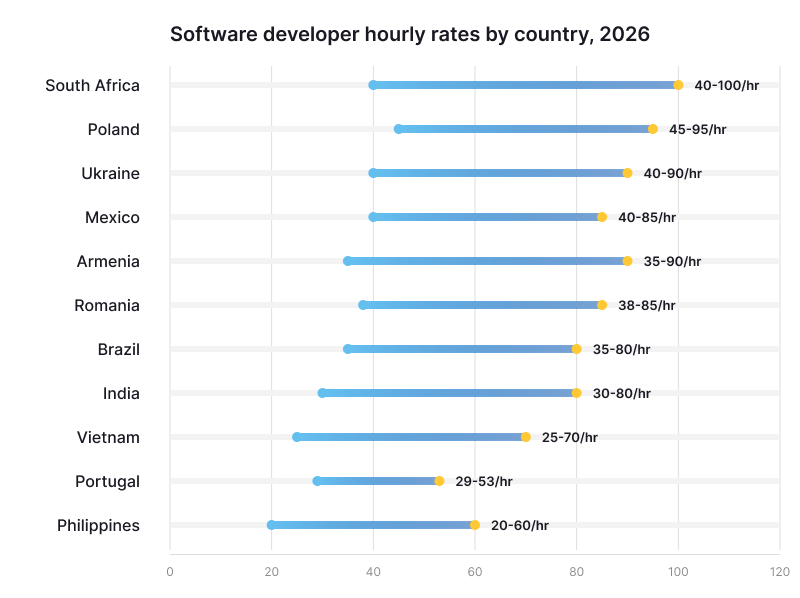
Junior-to-senior hourly rate range by country, 2026. Sources: Accelerance Global Software Outsourcing Rates & Trends Guide via DistantJob; Armenia figure via Armenian-Lawyer.com.
Poland
Poland is the default answer when a European company says, “we want to nearshore, but we want it done well.” The country has spent two decades building the deepest, most enterprise-ready engineering culture in Eastern Europe, and it shows in the numbers: Warsaw, Wrocław, and Kraków alone account for a meaningful share of the region's roughly 400,000 IT specialists, per Globaldev's Eastern Europe market breakdown, and Polish teams consistently rank near the top of independent coding assessments.
That reputation costs money. At $45–$95/hour for mid-to-senior developers, Poland is the most expensive stop in Eastern Europe; more than double Bulgaria's rates for comparable seniority. What buyers get for the premium is EU-native GDPR experience, full-day overlap with Western European business hours, and a vendor market mature enough to have hosted engineering centers for Google, Microsoft, and IBM. If a project is complex enough that architecture matters as much as code, Poland tends to earn its rate.
Ukraine
Ukraine's outsourcing industry has spent the past several years proving something most markets never have to: that engineering delivery can keep running through a full-scale war. Vendors invested heavily in business continuity — backup power, satellite connectivity, regional relocation benches — and by most accounts it worked; the sector kept exporting software even as other parts of the economy struggled.
The result is a market that still punches above its rate. At $40–$90/hour, Ukrainian senior engineers cost meaningfully less than their Polish counterparts for work that's often just as strong, particularly in fintech, embedded systems, and a fast-growing homegrown AI scene: Ukraine reportedly has more AI startups than anywhere in Eastern Europe except Poland. The country's roughly 300,000 developers include many alumni of large international outsourcing firms that built their early reputations on Ukrainian delivery centers, concentrated in established hubs like Kyiv, Lviv, Kharkiv, Dnipro, and Odesa.
Ten QS-ranked STEM universities feed that pipeline with roughly 25,000 new graduates a year, and the talent is notably senior-heavy: most Ukrainian engineers bring six or more years of experience, with particular depth in distributed systems, cybersecurity, and machine learning. English fluency is strong enough at the mid-to-senior level that day-to-day collaboration with Western clients rarely needs translation, and the sector has kept exporting through remarkably difficult conditions, a track record that keeps enterprise clients coming back.
Romania
Romania rarely gets top billing in outsourcing conversations, which is a little strange given the numbers. Its roughly 202,000 tech professionals are concentrated in Bucharest and a fast-growing Cluj-Napoca scene, rates run $38–$85/hour for mid-to-senior work (meaningfully below Poland) and the country has quietly built one of Eastern Europe's strongest multilingual talent bases, useful for clients working in French or German as well as English.
What Romania lacks is Poland's brand recognition or Ukraine's battle-tested delivery reputation. What it offers instead is a straightforward value proposition: EU membership, GDPR-native compliance, and enterprise-capable engineering at a genuine discount to its higher-profile neighbors. For companies willing to do slightly more vendor diligence in exchange for a better rate, it's worth a serious look rather than an afterthought.
Armenia
Armenia doesn't belong to the EU or to any of the usual Eastern Europe shorthand, and that's part of what makes it interesting. Yerevan's tech scene has grown out of a genuinely unusual combination: a Soviet-era mathematics and engineering education tradition, a modern push led by programs like the TUMO Center for Creative Technologies, and a government actively courting outsourcing investment. The result is an IT sector that the industry now values at roughly $2.3 billion, with over 1,250 active IT companies and a talent pool that's crossed 30,000 professionals: still small next to Poland or Romania, but growing faster than either.
Armenia's real differentiator is geography: sitting at UTC+4, it's positioned to bridge European mornings and Asian afternoons in a single workday, something none of the other Eastern European or Caucasus markets can claim as cleanly. Rates run $35–$90/hour for mid-to-senior developers, in the same band as Romania, with particular strength in AI, DevOps, and database engineering. The honest caveats: English proficiency is described as moderate rather than strong, the country doesn't yet show up on most global outsourcing indexes the way Poland or India do, and its far smaller pool means it suits a focused team, not a rapid 30-person build-out. For a company already comfortable working across time zones, though, Armenia is a legitimate (and still relatively undiscovered) option to shortlist alongside Georgia and the more established Caucasus-adjacent markets.
India
No other country on this list operates at India's scale, and that fact shapes everything about how to approach outsourcing there. With an estimated 5.8 million software developers (more than the next several countries on this list combined) India can staff a 50-person team in the time it takes other markets to staff five. Rates of $30–$80/hour for mid-to-senior talent remain competitive at that scale, and the country's IT services industry has four decades of experience serving nearly every vertical from banking to aerospace.
The trade-offs are well documented, precisely because the market is so large and so mature: quality varies enormously by vendor, which makes reference-checking non-negotiable rather than optional; the 9.5-to-13-hour gap with U.S. time zones usually means real-time collaboration requires a dedicated night shift on India's side; and the country's data protection framework, the 2023 Digital Personal Data Protection Act, is newer and less tested in enforcement than GDPR. None of that makes India the wrong choice; it makes India the right choice for a specific kind of project, one that needs scale more than it needs daytime overlap.
Vietnam
Vietnam is the outsourcing market that improved its standing the most over the last five years. What used to be a manufacturing-first economy has built a software industry projected to reach $2.63 billion in IT services revenue in 2026, backed by consistent government investment in digital skills and a fast-growing engineering workforce of more than 560,000.
Cost is still the headline: at $25–$70/hour for mid-to-senior developers, Vietnam undercuts every Eastern European market and most of Latin America, without the quality gap that discount used to imply. The country has built real specialization in web and mobile development and, increasingly, QA at scale. What it hasn't built yet is the deep senior bench of a more established market (Vietnamese teams tend to be stronger at execution than at leading architecture from a blank page) and English proficiency, while improving, still trails the Philippines and most of Eastern Europe. Plenty of companies solve both problems the same way: pairing a Vietnamese execution team with senior architectural oversight from Eastern Europe or Portugal.
The Philippines
The Philippines built its outsourcing reputation on the phone, not the keyboard, and that history still defines the market's real strength: English. The country ranks 28th globally and 2nd in Asia on the EF English Proficiency Index, ahead of India, and decades of BPO work have made U.S.-style communication (and even U.S. night-shift scheduling) is completely normal. Roughly 60% of the country's outsourcing workforce already works overnight hours to overlap with American clients.
That heritage cuts both ways. Rates of $20–$60/hour are genuinely competitive, and the roughly 1.9 to 2 million people working in IT-BPM roles give the market real scale. But the industry's center of gravity still sits closer to customer support, QA, and blended technical/customer-facing work than to deep, specialized software engineering — and attrition in BPO-adjacent roles can run 30–40% annually, a real consideration for any project that depends on team continuity. The Philippines answers a specific question well: does this project need English fluency and U.S.-hours coverage as much as it needs raw engineering depth?
Mexico
For a U.S. company, Mexico solves a problem that no Asian or even Eastern European market fully can: the clock. Guadalajara, increasingly called Mexico's Silicon Valley, sits in Central Time, one hour off the U.S. East Coast, which means a Mexican developer's entire workday overlaps with an American one. That fact, more than any cost figure, is why Mexico has become the default nearshore choice for U.S. product teams that need daily, real-time collaboration.
The numbers back it up: roughly 560,000 developers, rates of $40–$85/hour for mid-to-senior talent, and a tech-park infrastructure the Mexican government has actively cultivated for over a decade. The catch is that Mexico is no longer a secret — demand from U.S. companies has pushed rates up faster than in most of Latin America, and the strongest talent concentrates in a handful of metro hubs rather than spreading evenly across the country.
Brazil
Brazil is Latin America's scale play. With roughly 759,000 developers, it has the largest tech workforce in the region by a wide margin, fed by a booming fintech and e-commerce sector that's produced a genuinely deep bench in mobile and enterprise development. Rates of $35–$80/hour sit comfortably below Mexico's for comparable seniority, and São Paulo has become one of the most credible tech hubs in the Southern Hemisphere.
The friction points are less about talent and more about doing business: Brazil's tax and regulatory system has a reputation for complexity that trips up companies unfamiliar with it, and English proficiency, while solid within the tech sector specifically, is more variable than in Mexico or Argentina once you look past the top vendors. Companies that work with an established partner rather than hiring directly tend to sidestep most of this friction — a large part of why the market for Brazil-focused outsourcing intermediaries is as developed as it is.
Portugal
Portugal is the quiet favorite that took the rest of the industry by surprise. Lisbon and Porto weren't on most outsourcing shortlists a decade ago; now they're a default answer for U.S. and U.K. companies that want EU-grade compliance and genuine U.S. East Coast morning overlap from the same location. The country's time zone — the same as London, with a few usable hours of overlap with U.S. Eastern mornings — is arguably its best asset, and its roughly 262,000 ICT professionals bring native GDPR experience without needing to explain it.
The market is still young relative to Eastern Europe, though, and it shows in two ways: the talent pool is the smallest of any country in this guide, better suited to a focused team than a 40-person build-out, and rates have climbed 8–12% in the past two years alone as demand outpaces supply. At $29–$53/hour for mid-to-lead talent, Portugal is no longer the hidden discount it was a few years ago — but for EU compliance plus partial U.S. overlap in one package, it still has few real competitors.
South Africa
South Africa is the destination most outsourcing guides forget to mention, and that's precisely why it's worth watching in 2026. The wider Middle East and Africa region is now the fastest-growing outsourcing geography in the world, expanding at a projected 13.2% annual rate through 2031, and South Africa — specifically Cape Town and Johannesburg — is the most mature market on the continent positioned to capture that growth.
Its biggest structural advantage is one most companies don't think to look for: a time zone that sits within an hour or two of nearly all of Western Europe, English as a native business language, and a genuinely lower cost base than Eastern Europe for comparable work ($40–$100/hour). What it doesn't have yet is a well-documented talent pool size or the decades of vendor track record that Poland or India can point to — due diligence takes longer here, and references matter more than a polished sales deck. For European buyers willing to do that extra homework, South Africa offers something increasingly rare: real cost and time zone advantage in a market that hasn't been fully discovered yet.
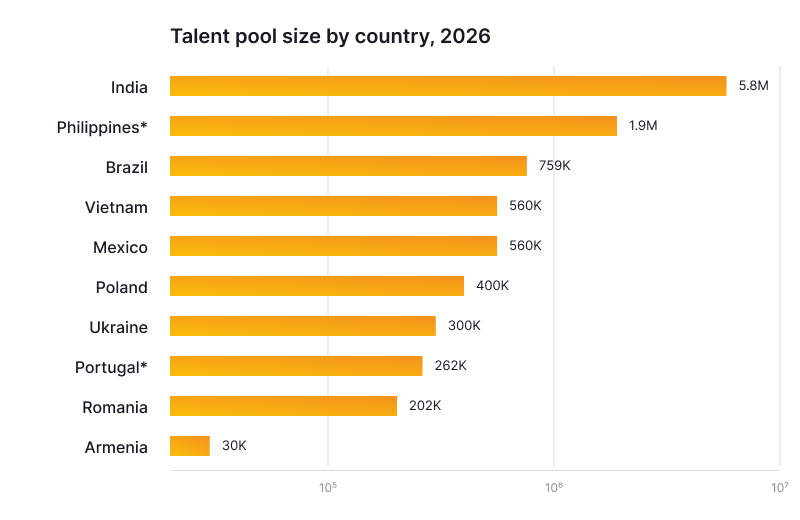
The gap on that chart is the whole story of India's place in this market: its talent pool is roughly three times the Philippines' and more than 20 times Portugal's. Scale like that is a genuine advantage for large build-outs, but it's also why quality varies so much by vendor — a market that size can't be uniformly excellent, and averages hide as much as they reveal.
How to choose among them
A few rules of thumb cut through most of the decision faster than a formal scoring matrix:
- If the project needs daily, real-time collaboration with a U.S. team — Mexico wins on time zone alone.
- If it needs EU compliance experience and can tolerate a partial time zone gap — Poland, Romania, or Portugal, roughly in that order of talent-pool size versus cost.
- If it needs raw scale, fast — India, with the caveat that vendor vetting matters more here than anywhere else on this list.
- If cost is the primary constraint and the work is well-specified — Vietnam or the Philippines, paired with strong documentation to offset the time zone gap.
- If the work is customer-facing as well as technical — the Philippines' English fluency and BPO heritage are hard to beat.
- If you're an early mover willing to do extra diligence for a cost and time zone edge — South Africa is the one to evaluate before it gets crowded.
- If the work benefits from a single team bridging European and Asian business hours in one workday — Armenia is worth a look, for a focused team rather than a large build-out.
Final thoughts
The country-level detail matters more than any regional label. “Eastern Europe” spans a nearly 3x rate difference between Romania and Poland; “Latin America” spans a similar gap between Mexico and Brazil. Pick a shortlist using the comparisons above, then vet specific vendors in those countries against your project's actual constraints — budget, time zone, compliance needs, and how much architectural ownership you want the outsourced team to hold.
If you want help scoping which country or hybrid model fits your specific project, get in touch with Globaldev's team.